The 2026 Decision Every SaaS Growth Team Now Faces
Most SaaS growth teams entering 2026 are managing tool sprawl from an abundance of AI SEO options. You can wire Google Search Console and GA4 into a dashboard, layer a rank-tracking API on top, string together a prompt-based writing workflow, or hand the whole pipeline to a platform that promises to publish for you. Each vendor demo looks convincing in isolation, and the more tools you evaluate, the harder it becomes to say which combination fits your team. The core ambiguity is ownership: engineering wants to build, marketing wants speed, and finance wants a number that holds up next quarter, and no one has defined which layer each stakeholder actually owns.
The clarity on the other side of this decision is knowing which layer of your stack to own, which to rent, and which to hand off entirely, defensible with cost, freshness, and risk figures rather than preference. That means no ambiguity about who maintains the pipeline, who approves the content, and what happens when a data source goes stale. The choice, in plain terms, comes down to two directions: assemble a signal-first SEO workflow from owned data sources and APIs, or adopt an integrated platform that ingests those signals and executes end to end.
We judge each option against the same six criteria and put the trade-offs side by side so the fit becomes clear for your specific situation.
The reason this question surfaced now is timing. AI content generation matured faster than the analytics, search, and governance signals needed to steer it safely, so teams found themselves able to produce content at volume with no reliable way to decide which topics deserved the effort, or whether any of them were safe to publish. Generation got cheap before judgment got automated.
This guide is written for SaaS growth, SEO, and content operations teams weighing engineering capacity against speed-to-value. If you have spare backend engineers and a genuine data moat, your calculus differs from a three-person content team that needs to ship next week, and the framework below accounts for both.
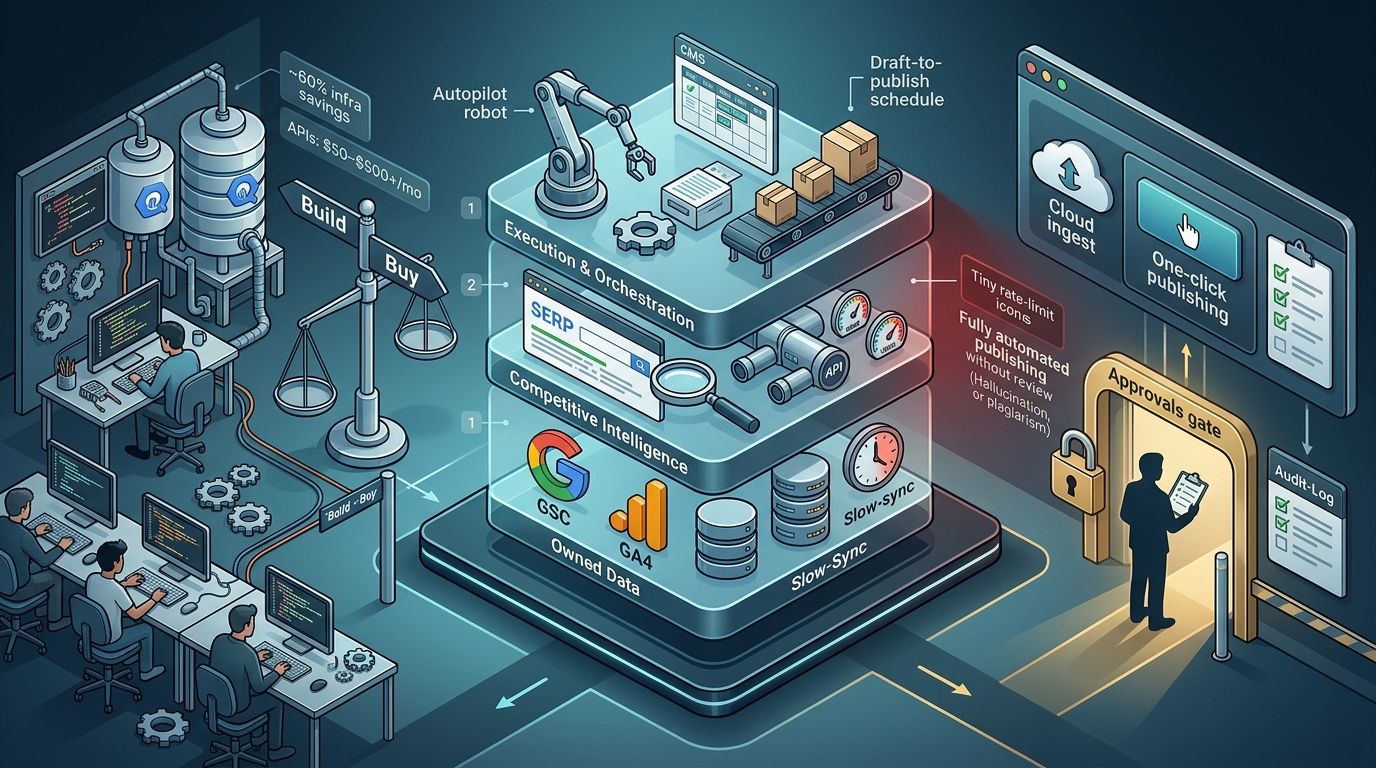
We use a three-layer mental model throughout. The data foundation is GSC and GA4, the owned sources that describe your own performance. Competitive intelligence is SERP automation, the external view of the market you cannot see from your own data. Execution and orchestration is the autopilot platform category, which turns signals into briefs, drafts, and published pages. Every option below is judged against six identical criteria: cost, setup time, signal freshness, workflow coverage, governance, and publishing risk.
One data point frames the entire decision. External SEO data APIs can cut up to 60% of the cost and development time of building data infrastructure in-house, though this figure is best read as a modeled estimate rather than a verified industry benchmark. What it establishes is the real question: beyond the question of whether you build at all, which layer you choose to build, because that decision is where the cost and time concentrate. That question starts with the layer you already own.
Option One: GSC and GA4 as the Owned Data Foundation
Google Search Console and GA4 are free, first-party, and already connected to your domain, which makes them the natural floor of any AI SEO stack. GSC is your pre-click source of truth, reporting impressions, clicks, click-through rate, queries, and average position, so it describes how Google presents you before anyone lands on the page (Google). GA4 is the post-click behavior source, reporting sessions, engagement, conversions, and revenue, so it describes what happens after the click. Together they cover the full arc of a search visit, but only for your own property.
The reconciliation reality trips up almost every team that assumes the two should agree. GSC clicks and GA4 sessions are calculated differently and were never meant to match, so the correct operating principle is watching whether the trends move together rather than chasing numeric parity between them. When clicks rise and sessions rise with them, the story holds; when they diverge sharply, something in your measurement setup needs attention.
The causes of that divergence are worth planning around because each one is a known, fixable source of noise:
- Timezone differences, where GSC and GA4 use different reporting timezones, so a single calendar day can cover two different 24-hour windows.
- Attribution and scope differences, because GSC counts only Google organic clicks while GA4 sessions can begin from any channel and some organic clicks never start a fresh session.
- Canonical URL reporting, where GSC attributes performance to the canonical it chose while GA4 fires on whatever URL actually loaded.
- Bot filtering and deduplication, which GSC applies before you ever see the data.
- Consent opt-outs, where a user who denies cookies or blocks the tag produces a GSC click with no matching GA4 session.
Setup is close to instant, but freshness is the constraint that shapes what this layer can do. GSC data typically runs about two days behind, and GA4 retains event-level data for two months by default, extendable to fourteen months in the admin settings, which matters the moment you want year-over-year query analysis (Google Analytics Help). The combined effect is a structural gap for near-real-time alerting: if a ranking drops today, you will likely learn about it two days later.
This is where the owned foundation stops on its own. Dashboards built on GSC and GA4 monitor performance, but they do not diagnose why a page slipped, prioritize which page to fix first, or execute the fix. Any deep join of query-level GSC data against GA4 behavior requires exporting both into a BigQuery warehouse and building the model yourself, which is real engineering work rather than a connector you switch on. If you already suspect your alerting needs outrun a two-day delay, that BigQuery build is the fork in the road worth mapping before you commit budget elsewhere.
Judged against the six criteria, this layer scores well on cost, since it is free, and reasonably on setup, since connection is fast, though the warehouse build pushes real setup time up sharply. Signal freshness is capped by the two-day delay, workflow coverage is limited to monitoring, and governance and publishing risk do not apply because nothing here publishes anything. The decisive limit is structural: these tools can only ever show you your own performance, and there is an entire competitive environment they cannot see.
Option Two: SERP Automation for the Competitive Environment
GSC tells you how you rank; it says nothing about who ranks above you, how their content is framed, or what the search result page looks like around you (iBeam Consulting). That blind spot is the structural gap SERP automation fills, because competitive visibility, shifts in search intent, and changes to SERP features such as AI Overviews all live outside your own data and can only be observed through external SERP collection.
Mature commodity SERP APIs have converged on a fairly standard feature set:
- Rank tracking across target keywords and locations.
- SERP feature and AI Overview monitoring, so you can see when a query gains a featured snippet or an AI answer box.
- Keyword research with volume and difficulty signals.
- Backlink intelligence for competitor link profiles.
- Location-specific results, since rankings vary by geography.
The price ladder gives you a useful reference for both cost and the seriousness of the setup involved. DataForSEO runs on true pay-as-you-go with a minimum deposit around $50, which suits teams that want to pay for exactly what they pull. Subscription platforms sit higher: SE Ranking's plans land in the roughly $149-per-month range, Majestic's API has historically been quoted near $399.99 per month, and the Ahrefs and Semrush tier reaches roughly $500 per month for advanced plans. Treat the higher figures as vendor-specific and worth confirming directly, since API pricing shifts and is not always published cleanly.
The cost that does not appear on any pricing page is the engineering hidden inside a SERP layer. An API returns raw JSON, and turning that into a reliable feed means writing and maintaining code to handle authentication, pagination, parsing, rate limits (SE Ranking's data API defaults to 10 requests per second, for example), retries when calls fail, and storage for the results you accumulate. This is the same maintenance burden the framing statistic points at: the API removes the scraping problem but hands you an integration and reliability problem in its place.
There is also a coverage pattern worth naming. No single API covers everything well, so teams that take this layer seriously pick one primary source for the bulk of their needs and supplement it with one or two specialists, which means the SERP layer is rarely one contract and often three, each with its own auth, limits, and failure modes.
The reliability stakes scale with volume, and one agency reference case makes the point concrete: an agency managing roughly 300 client domains, where a single stale data pull or a hidden monthly cap silently breaks automated reporting across dozens of accounts before anyone notices, and the credibility cost of sending clients wrong numbers dwarfs the API bill. Treated as a reference case rather than a general benchmark, it shows that building this layer well is entirely possible but demands ongoing ownership, which raises the harder question: once you have all these signals flowing, who orchestrates them into actual work?
Option Three: Autopilot Platforms for Execution and Orchestration
The autopilot category answers the orchestration question by claiming to run the whole pipeline end to end: keyword research starting from a seed topic, SERP-driven content briefs, full-length drafting with internal links added automatically, on-page optimization against a target, and scheduled publishing straight into your CMS. In principle, a signal enters one end and a live blog post exits the other with no manual step in between.
The pricing and volume map is where planning starts. Across the category, monthly plans run from roughly $19 to $299, and the cost per article lands in a band from about $3.30 to $13, segmented by who is buying (Sight AI). At the low end sit side projects and solo brands generating a handful of articles; the middle serves growing sites publishing a few dozen a month; the top tier targets agency books managing many client domains at once. Individual vendors fall outside that band in both directions, so treat any single plan's per-article figure as a data point to confirm rather than a category rule.
A caveat applies to any ranking of these tools. Much of the head-to-head benchmarking circulating online is authored by the platforms themselves, so a study that names a clear winner should be read as vendor-influenced; the pricing specifics inside such studies are usable, but the conclusions are not independent evidence.
The build-versus-stitch comparison that vendors often cite is worth carrying as an illustrative model rather than a verified fact. The typical framing puts a do-it-yourself stack of separate tools at $160 to $220 per month plus six or more hours a week of hands-on assembly to produce 10 to 15 articles, against an integrated platform that folds those steps into one subscription and far less manual time. The direction is plausible, but the exact figures come from parties with an interest in the answer, so use them to structure your own calculation rather than as a benchmark to quote.
The headline statistic from the category, that a platform can produce 30 articles a month at $3.30 each, is a self-reported figure and should be flagged as such. Even taken at face value, it settles a cost question while leaving the important one untouched, because cost per article says nothing about whether those articles are accurate, on-brand, or safe to put in front of customers. A cheap article that hallucinates a product claim is not cheap.
There is also a definitional tension the category rarely states out loud. Many vendors treat any tool that requires a human to approve content before it goes live as mere assist rather than true autopilot, which means the very control that keeps you safe is the one the category defines as a downgrade (Mastra). That framing pushes the risk conversation to the front rather than the footnotes.
Governance and Publishing Risk Across All Three Options
Governance sits apart from the other five criteria because automation that publishes without oversight concentrates brand, legal, and factual risk at exactly the point where you have the least visibility. A stale ranking number costs you a bad decision; an auto-published page with a fabricated statistic or a competitor's trademark puts brand, legal, and factual exposure on your live domain, under your name, before anyone reviews it.
The documented weakness across the autopilot category is that these tools address review lightly and rarely ship the controls that make unattended publishing defensible (Microsoft). What is typically missing includes:
- Approvals workflows that route a draft to a named reviewer before it can go live.
- Hallucination detection to flag unsupported factual claims.
- Plagiarism and fact checks run automatically against sources.
- Audit logs recording who changed what and when.
- Rollback to revert a published page cleanly.
- Role-based access so junior operators cannot push to production alone.
The publishing-risk tension is direct and unresolved. The human-in-the-loop approval gate that reduces every risk above is the same feature many vendors define as disqualifying a tool from autopilot status, so the market rewards removing the control that protects you. Any team adopting this category has to decide consciously which side of that line it wants to stand on.
Two things cannot be asserted here, and we will not pretend otherwise. There is no independent evidence in the available material showing that any autopilot approach improves rankings or indexing, so claims of ranking lift stay unsupported, and claims that a given tool's output is inherently safe to publish stay unsupported as well. Absence of evidence is not proof either way; it simply means these questions belong in your own trial instead of a vendor's headline.
One vendor-authored benchmark illustrates how easily validation gets skipped: a test spanning ten platforms with no human editing reported a total spend of $2,310 to generate and publish content across all of them. Read charitably, it shows the throughput is real; read carefully, it shows a full ten-platform run completed with quality validation never once in the loop, which is precisely the shortcut a team is tempted to take right before an enterprise commitment.
That temptation exposes three overpayment traps worth naming plainly: buying an enterprise autopilot tier before you have validated a single published output, signing an annual contract with no 30-day trial that lets you actually publish and review real pages, and paying for a platform that turns out to generate drafts only, leaving the publishing step, and its risk, back on your plate. Those traps become easier to see when the four operating models are compared against the same criteria.
Side-by-Side Comparison of the Four Approaches
The four practical configurations most SaaS teams choose between are the owned foundation alone, that foundation plus a custom SERP layer, a stitched prompt-based writing workflow, and an integrated autopilot platform. Judged against the same six criteria, they separate cleanly.
| Criterion | GSC + GA4 only | GSC + GA4 + custom SERP layer | Stitched prompt-based AI writing | Integrated autopilot platform |
|---|---|---|---|---|
| Cost | Free (tools); engineering time for any warehouse | Free tools + API ladder (~$50 pay-as-you-go to ~$500/mo) + build cost | ~$160–$220/mo across separate tools (illustrative model) | ~$19–$299/mo; ~$3.30–$13 per article |
| Setup time | Minutes to connect; weeks if BigQuery join is built | Weeks: auth, pagination, rate limits, retries, storage | Days to assemble; ongoing manual stitching | Hours to days; vendor-managed ingestion and scheduling |
| Signal freshness | ~2-day GSC delay; GA4 2-month default retention | Adds external competitive data, subject to API freshness, caps, and limits | Depends on whatever data you feed the prompts | Vendor-managed ingestion on a schedule you set |
| Workflow coverage | Monitoring only; no diagnosis or execution | Monitoring + competitive intelligence; still no execution | Drafting, with manual research and publishing | Research to brief to draft to publish, end to end |
| Governance | Not applicable; nothing publishes | Internal build gives full control if you invest in it | Fully manual; control depends entirely on your process | Thin defaults documented across the category |
| Publishing risk | None; read-only | None; read-only | Concentrated on the human doing the final paste | Highest, because unattended publishing is the selling point |
Cost tells only part of the story, and no row wins outright. The owned foundation is free but blind past your own domain. The custom SERP layer buys competitive sight at the price of ongoing engineering. The stitched workflow is flexible but leans entirely on the operator's discipline. The integrated platform buys speed and coverage while inheriting the category's thin governance. Which trade you should accept depends on team size, available engineering capacity, how much you need to control your own data, and how fast you need to see value, so the honest answer is that fit rather than a winner, is what this table is for. To decide fit, it helps to look at which layers of your stack are strategic enough to build.
Mapping Each Approach to Strategic Layers Using the Pace-Layered View
Gartner's pace-layered application strategy offers a clean lens for the build-versus-buy call (Gartner). It sorts systems into three speeds: systems of record change slowly and reward buying a standard solution, systems of differentiation change at a moderate pace and reward a hybrid of bought core plus custom extension, and systems of innovation change fast and reward building where the capability is central to how you grow. The question is never build or buy in the abstract; it is which layer each piece of your stack belongs to.
Applied to the AI SEO stack, GSC and GA4 ingestion behaves like a system of record. It is standardized, changes slowly, and confers no advantage from being rebuilt in-house, so it should be adopted rather than reengineered. SERP intelligence and content execution sit closer to differentiation and innovation, because how you read the competitive environment and how you turn signals into published work can genuinely separate you from a competitor running the same off-the-shelf tools.
The path this framing endorses is explicitly hybrid: buy the ingestion and execution layers, then build custom extensions only where they create real advantage. You do not earn points for reimplementing a GSC connector; you earn them for a proprietary way of reading signals or a workflow tuned to your niche that no vendor ships by default.
There is an incentive risk worth naming honestly. Internal engineering teams sometimes favor building for reasons that have little to do with strategy, such as preserving institutional knowledge or job security, and while this is an anecdotal signal rather than documented evidence, it is common enough that decision-makers should watch for a build case that rests on preference rather than differentiation.
SEO carries its own build-versus-buy nuances beyond the generic framework. Data portability matters, because a tool that locks your historical data inside its walls raises your switching cost. Proprietary-metric lock-in, where a vendor grades content against a score only it calculates, can quietly make you dependent. Deep integration with internal systems can justify a build when your CMS or data warehouse is genuinely non-standard. And white-label control matters for agencies that need to present the output under their own brand.
Nuanta maps to the hybrid path in this framing. It combines signal ingestion, including GSC trend analysis and a five-source signal engine spanning search, competitors, and community sources such as Reddit and forums, with agentic execution that produces research-backed, E-E-A-T-scored articles and publishes through more than a dozen CMS integrations, without asking your team to build or maintain the underlying pipelines. That is the buy-the-ingestion-and-execution, keep-your-differentiation model in practice, and it is where the up-to-60% saving in infrastructure cost and development time is meant to land: on the plumbing you should never have been building by hand. That leaves one practical question before budget moves: which layer should you decide on first?
What to Decide First Before Committing Budget
Before any budget moves, resolve one question: which layer genuinely differentiates your growth. That is the only layer worth building, and for most SaaS teams it is neither the GSC and GA4 ingestion, which every competitor also has, nor a rank-tracking API that returns the same JSON to everyone. If nothing in your stack is a true differentiator, the case for building weakens considerably and the decision becomes which vendors to trust.
The validation step most teams skip is the cheapest insurance available. Run a short, edit-in-the-loop publishing trial before signing any annual autopilot contract, generating real articles, reviewing them properly, and shipping a handful to a live but low-stakes section of your site. Treat cost per article as a secondary metric to output quality, because a $3.30 article you have to rewrite is more expensive than a $10 one you can publish as-is.
Require one governance control from any vendor regardless of what else it offers: an audit trail paired with an approvals workflow. Given how thinly the category addresses oversight, this is the single non-negotiable, because it is the control that lets you attribute, review, and reverse anything that reaches your domain.
Define your signal-freshness threshold upfront as well. Decide whether your alerting genuinely tolerates the roughly two-day GSC delay or whether your team needs warehouse-level joins for faster, deeper diagnosis, because that one answer determines whether you spend engineering effort on a BigQuery build or leave the foundation as it ships.
Where most teams get stuck next is predictable: they build a custom pipeline to fill a gap, then spend the following year maintaining it, patching rate limits and parsing errors and stale feeds, only to find a hybrid ingestion-plus-execution layer would have covered the same gap without the upkeep. The build felt cheaper on day one and quietly became the most expensive line item by month twelve.
The recommendation that follows is straightforward. Fix the owned data foundation first, since it is free and everything else depends on it. Buy the competitive-intelligence and execution layers unless one of them is genuinely your differentiator, because rebuilding commodity infrastructure spends the engineering capacity your real advantage needs. And keep a human approval gate on anything that publishes, no matter how confident the vendor is that approval disqualifies a tool from being autopilot. Whichever direction fits, the discipline is the same: decide the differentiating layer, run an edit-in-the-loop trial before committing a year of budget, and confirm the output clears your own quality bar before anything reaches your live domain.