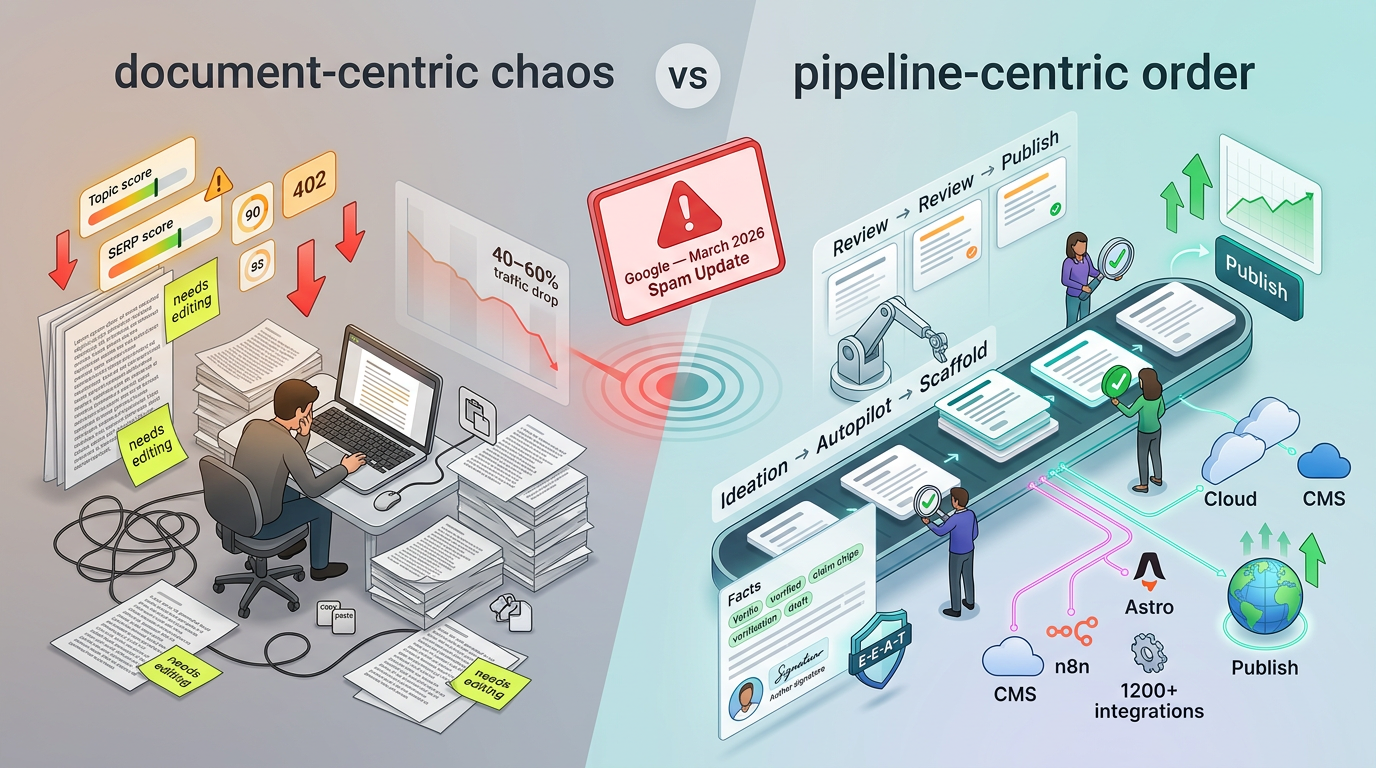
TL;DR. Frase is a SERP-NLP editor with an AI Agent layer on top. Nuanta is a research-first content pipeline with E-E-A-T quality gates between every stage. Frase wins on solo-writer ergonomics and speed. Nuanta wins on multi-stage governance and fact injection. Pick by whether your bottleneck is writing speed or content quality at team scale.
SEO Scores Stopped Mattering. Here's What Replaced Them.
The old playbook was simple. Fire up Frase or Surfer, match the SERP, chase the Topic Score until it turns green. Agencies built entire businesses around this loop. It worked for a while.
Then Google's March 2026 updates changed the rules. They didn't penalize AI content as a category. They targeted scaled content abuse: high-volume, unedited AI pages with no editorial oversight. The new requirement is honestly pretty straightforward: demonstrate that a human with genuine expertise touched the content before it went live. Authorship transparency, E-E-A-T signals, documented editorial review. Not optional anymore.
Teams looking for a Frase alternative aren't shopping for features. They're looking for a different operational model entirely.
Where Frase Still Works (and Where It Doesn't)
Credit where it's earned: Frase pioneered SERP-driven content briefs. For solo writers who need to quickly understand what a SERP expects, its research-to-draft workflow is fast and intuitive.
Where it falls short:
- Scoring precision is weak. Third-party assessments show Frase's content score correlates with ranking at roughly 0.10 (vs Surfer's 0.28). Neither is great, but that gap matters when your whole workflow revolves around the score.
- AI output needs heavy editing. Multiple independent reviews describe Frase's generated content as requiring "substantial editing" before publication. Generic intros, repetitive structure, no polish.
- No access to your knowledge. Frase can't ingest internal docs, product specs, or customer data. Its AI writes from public web knowledge only, which means every article sounds like an outsider wrote it.
- No editorial governance. Content can move from draft to live without a structured approval step. Governance lives in your Slack or your team's memory, not in the tool.
- Pricing crept up. Entry tier went from $39 to $49/month without proportional capability gains. Usage constraints create friction at volume.
Bottom line: Frase is a document editor with good research features. That's a ceiling, not a foundation. For solo writers doing 5-10 pieces a month, it's fine. For teams with editorial standards? Not enough.
Editor vs. Pipeline: The Core Difference
This comparison isn't really about features. It's about what "the unit of work" means.
Frase = document. You open it, work in it, close it. Every article is an island. Repeat for each piece. No structured handoffs, no approval gates, no role separation.
Nuanta = pipeline. A strategic brief enters a Kanban board. Autopilot generates scaffolding (not a finished article). Human experts refine through defined checkpoints: fact injection, brand voice alignment, editorial review. When approved, it publishes directly to your CMS with native support for 13+ platforms.
The operational difference compounds fast. Manual assembly per document doesn't scale linearly. Context-switching between research, writing, editing, and publishing for each piece creates friction that honestly just gets worse the more you publish.
Human-in-the-Loop: Why It's Structural, Not Cultural
Publishing at high volume without documented editorial review has become a significant risk pattern since March 2026. Not because there's a magic page-count threshold, but because volume without visible editorial process is exactly the pattern associated with scaled content abuse.
Industry data shows roughly 30% fewer processing errors when structured approval nodes are present.
Frase: no review/approval gate before publish. Nuanta: configurable approval checkpoints that require sign-off before content advances. You literally can't bypass it without someone deliberately removing the guardrail.
Chasing a 100% optimization score and producing content that demonstrates genuine expertise are not the same activity.
Fact Governance and Quality at Scale
When a tool's only objective is "cover the entities the top-ranking pages mention," the AI will mention them. Whether or not the statements are accurate, contextual, or useful. The output reads like someone skimmed Wikipedia at 3 AM.
Nuanta's approach:
- Multi-Task Chain of Thought prompting maintains reasoning continuity across the entire piece instead of generating section by section independently
- Facts tab lets teams load verified claims, research findings, expert quotes as structured inputs before drafting. The AI draws on actual information, not plausible-sounding guesses
- Brand voice training learns from existing content and applies consistency across teams. Article 47 sounds like it came from the same organization as article 3
The "substantial editing required" problem isn't just an inconvenience. It's a workflow tax that compounds at volume. Better source material and fact injection produce drafts closer to publish-ready from the start.
Decision Matrix: Which Tool Fits Your Situation
| Scenario | Frase | Nuanta | Key Deciding Factor |
|---|---|---|---|
| Solo writer, <10 articles/month | ✅ Good fit | Overkill | Frase's SERP research and quick-draft workflow is sufficient |
| Freelancer with multiple clients | 🟡 Workable | ✅ Better fit | Nuanta's project separation, brand voice per client, and Facts tab prevent cross-contamination |
| Agency, 3+ clients | ❌ Outgrown | ✅ Strong fit | Role-based workflows, approval gates, and multi-project Kanban prevent governance chaos |
| In-house team with editorial standards | ❌ No governance | ✅ Strong fit | Built-in review checkpoints enforce quality without relying on external project management |
| High-volume ops (20+ articles/month) | 🟡 Friction at scale | ✅ Designed for this | Pipeline orchestration, direct publishing, and integration layer eliminate manual bottlenecks |
| Teams needing fact verification | ❌ No mechanism | ✅ Core feature | Facts tab and SME integration inject verified claims; Frase relies on AI's general knowledge |
| Programmatic SEO / bulk generation | ✅ 100+ pages/batch | ❌ Not the focus | Frase supports batch generation; Nuanta prioritizes quality-governed output over raw volume |
How to Choose: Quick Guide
Stay with Frase if:
- You're a solo writer doing under 10 pieces/month
- You mostly need SERP research and a quick draft starting point
- You don't need team collaboration or editorial governance
- Your CMS is WordPress, Webflow, or Sanity
Move to Nuanta if:
- You need editorial approval gates built into the tool, not your Slack channel
- Multiple writers/editors work on content that must sound like it came from the same brand
- You have proprietary expertise (product docs, customer data, SME knowledge) that should be in every article
- You publish 20+ articles/month and manual assembly per piece is killing your team
- You need your content pipeline connected to your CMS, analytics, and project management in one system
Choose neither alone if:
- Your primary bottleneck is technical SEO, backlinks, or rank tracking. Both tools require separate platforms for those.
One thing worth knowing: this comparison was managed, drafted, and published through Nuanta's pipeline. The brief entered the Kanban board. Facts were loaded. The draft moved through editorial checkpoints. It published through the integration layer. The process is the proof.
 Try the Pipeline Yourself
Run your own keyword through both tools and compare the output. Nuanta offers a 7-day free trial with full access to the Signal Engine, Facts tab, E-E-A-T scoring, and auto-publish to your CMS.
Start Free Trial →Frequently asked questions
Should I switch from Frase to Nuanta?
If your bottleneck is a solo writer producing 5–10 articles per month, Frase Pro at $129/mo is hard to beat — its editor + AI Agent are sharp. If you have a multi-person content team, fact-check workflow, or need E-E-A-T gates between research, drafting, and publishing, Nuanta's pipeline architecture handles that natively. Switch only if governance is your real bottleneck, not writing speed.
Does Frase still beat Nuanta on anything?
Yes, on solo-writer ergonomics. Frase's keyword research + brief generator + in-editor optimization is a tight loop. It also ships an AI Visibility Tracker across 8 AI platforms — Nuanta doesn't have that yet. For programmatic SEO at low article cost ($49 Starter for 10 articles), Frase's per-article math is competitive.
Are SEO Content Scores really obsolete in 2026?
Mostly. The peer-reviewed Princeton/Cornell KDD 2024 GEO study, across 10,000 queries, found that AI-engine citations are driven by statistics with citations (+30%), expert quotes (+41%), and external sources (+30%) — not by Content Score grades. Scores correlate with old-school SERP ranking but don't predict AI Overview citations, which is increasingly where high-intent traffic lands.
What's the real cost difference at 10 articles per month?
Frase Pro at $129/mo includes 40 articles — about $3.22 per article on paper, but you're paying a writer separately. Add $200/draft = ~$203 all-in per article. Nuanta Writer at $99/mo includes 15 articles drafted, researched, and published — about $6.60 per article, with no human writer in the loop. Whether $200 of writer time is "worth it" depends on your fact-check needs.
Can I migrate my Frase Factbook content into Nuanta?
Partially. Nuanta's Knowledge Base accepts PDF, DOCX, Markdown, voice-note transcripts, and synced Google Docs. Frase Factbook exports as plain text or PDF — both formats import. What does NOT transfer is the cross-document relationships Frase builds during AI Agent runs; those need to be reconstructed via Nuanta's own ingest pipeline.
Useful materials
- Google March 2026 Core Update: What Changed & What To Do
- Google AI Content Policy 2026: No Percentage Limits | Creative Orbit
- LanG: A Governance-Aware Agentic AI Platform for Unified Security Operations (arXiv)
- Frase Content Guard: Auto-Fix Decaying Content | Frase.io
- How to Automate Your Content Workflow with Strapi and n8n
- n8n Integrations Documentation and Guides