
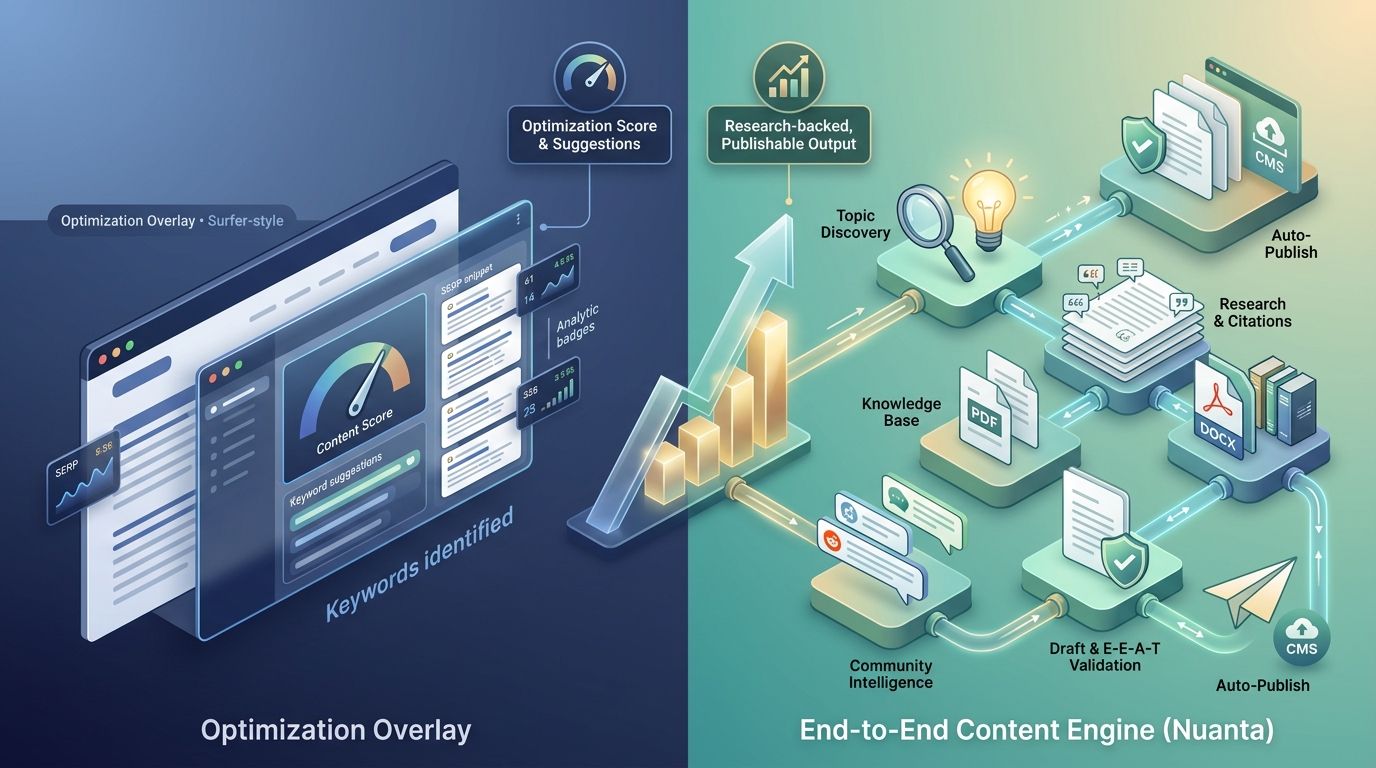
TL;DR. Surfer SEO is an optimizer — it scores content you've already written with a SERP-NLP grade. Nuanta is a content engine — it researches, drafts, validates, and publishes from scratch. They solve different problems. Pick based on whether your bottleneck is making good drafts better or producing drafted content at all.
Optimizer vs. Content Engine: Two Different Tools for Two Different Problems
Most SEO content tools assume you already have writers, already know what to write about, and already have a publishing workflow. They score what you've written. That's an optimization overlay.
Nuanta is a content engine. The pipeline handles the entire sequence: discovering what to write about, researching it deeply with cited sources, drafting, validating against E-E-A-T criteria, and publishing to your CMS. Different starting point, different output.
Bias disclosed: this article was researched, written, and published using Nuanta's pipeline. It tries to be specific about where Surfer genuinely excels and where Nuanta falls short.
Where Surfer SEO Excels
- SERP-based NLP analysis is Surfer's core strength. 500+ web signals, term frequency, heading structure, semantic relevance. Proven approach with a massive user base.
- Content Editor as a scoring layer works great if your team already writes content. Writers paste their draft and watch the Content Score update in real-time as they hit NLP targets.
- Live integrations today. Google Docs, WordPress, Jasper, plus the free Keyword Surfer Chrome extension. Nuanta's CMS integrations are still marked as coming soon, so Surfer has a practical advantage here right now.
- Content audit and refresh. Surfer has this. Nuanta doesn't yet.
Where Surfer's Model Stops
- No topic discovery. You need to arrive with a keyword already chosen (typically from Ahrefs or Semrush).
- No research pipeline. No source compilation, no cited Factbook. Research is on you.
- No end-to-end publishing workflow. Beyond the editor and its integrations, there's no pipeline from topic to CMS-ready article.
- No knowledge base. Can't ingest your company's PDFs, internal docs, or expert interviews.
- Content Score ≠ rankings. Independent tests show weak correlation between high Content Scores and actual ranking improvements. Worth knowing before building your strategy around it.
What Nuanta Does Differently
Signal Engine: 5 Data Sources vs. SERP-Only NLP
Surfer analyzes what's already ranking. Nuanta's Signal Engine identifies what's worth writing about from five sources:
- Keyword gaps from competitive analysis
- Google Search Console trends revealing emerging opportunities
- Community intelligence from Reddit, forums, and Q&A platforms (topics that don't show up in keyword tools yet)
- Competitor content gaps at entity and subtopic level
- Internal knowledge base (your docs, voice notes, proprietary expertise)
End-to-End Pipeline
Brief → Outline → Deep research with cited Factbook → Draft → E-E-A-T validation → Auto-publish to CMS
The Factbook is the key differentiator. Before writing begins, the pipeline compiles a structured research document with cited sources. Claims in the final article trace back to their origins.
Knowledge Base
Surfer doesn't have this category at all. Nuanta ingests:
- PDFs and DOCX (product docs, whitepapers, internal guides)
- Site crawls (so new articles reference and link to existing content)
- Voice-to-text (record an SME for 15 minutes, get structured KB entries)
E-E-A-T Score vs. Content Score
Two fundamentally different measurements:
- Surfer's Content Score: how well your content matches NLP patterns from currently ranking pages. Relevance and completeness relative to SERPs.
- Nuanta's E-E-A-T score: evaluates cited sources, knowledge base usage, factual substantiation, and structural expertise signals. Pass/fail gates at each pipeline stage.
Neither guarantees rankings. They optimize for different things.
Pricing: Not an Apples-to-Apples Comparison
The unit of output is different. Surfer gives you an optimization pass for content you've already written. Nuanta gives you a complete, research-backed, publishable article.
Surfer SEO
| Plan | Price | What You Get |
|---|---|---|
| Essential | $99/mo | 30 Content Editor credits + 5 AI articles |
| Scale | $219/mo | 100 Content Editor credits + 20 AI articles |
Cost per optimization: ~$3.30 at full utilization. Credits reset monthly. Heavy users report exhausting allowances within two weeks.
Nuanta
| Plan | Price | Complete Articles | Team Seats |
|---|---|---|---|
| Solo | $49/mo | 5 | 1 |
| Writer | $99/mo | 15 | Up to 5 |
| Publisher | $199/mo | 50 | Up to 50 |
Cost per complete article: $9.80 (Solo), $6.60 (Writer), $3.98 (Publisher). Each includes the full pipeline.
Side-by-Side
| What You Get | Surfer SEO | Nuanta |
|---|---|---|
| Entry price | $99/mo (Essential) | $49/mo (Solo) |
| Core output | Optimization score + keyword suggestions | Complete research-backed article |
| Research included | No | Yes (cited Factbook) |
| Writing included | Partial (AI credits) | Yes (full draft) |
| Publishing | Via integrations (live today) | Via pipeline (CMS integrations coming soon) |
| Knowledge base | Custom Knowledge feature | Full KB (PDFs, DOCX, voice notes, site crawls) |
What Neither Tool Solves
- Technical SEO, backlinks, link building. Both require Ahrefs, Semrush, or Screaming Frog for those.
- Reliable keyword volume data. Surfer's estimates show significant discrepancies vs. Ahrefs. Nuanta uses signal-based suggestions instead.
- Guaranteed rankings. Content quality is one factor among many. Any tool that implies otherwise is lying.
- Replacing human editorial judgment. Both tools benefit from a human editor reviewing before publish.
When to Choose Which
Choose Surfer If:
- You have writers and need a real-time NLP optimization layer
- You need live integrations with Google Docs, WordPress, and Jasper today
- Topic discovery happens in Ahrefs or Semrush and you just need the optimization piece
- You're auditing/refreshing a large existing content library
Choose Nuanta If:
- You need the full pipeline from signal detection through publication and don't have a separate writing team
- Your competitive advantage comes from proprietary expertise that should be in every article
- You want topic discovery from 5 signal sources including community intelligence
- You're publishing regularly and need cost-per-article efficiency ($3.98-$9.80 per complete article)
Choose Neither Alone If:
- Your bottleneck is technical SEO, backlinks, or rank tracking
What Nuanta Still Needs to Prove
- Independent case studies. Most performance data comes from internal dogfooding. Third-party validation is in progress.
- Shipping integrations. CMS integrations (WordPress, Ghost, Shopify, HubSpot) are in development, not live yet.
- Content audit/refresh. Surfer has this. Nuanta doesn't.
The Recommendation
Try both. Pick the same keyword, run it through each tool. Surfer gives you an optimization report for content you write. Nuanta gives you a researched, drafted, E-E-A-T-validated article. The output difference will tell you more than any comparison article.
Frequently asked questions
Should I use Nuanta or Surfer for a new blog with zero existing content?
If you have writers (in-house or freelance), Surfer's optimization layer makes their drafts rank-readier. If you don't have writers, Surfer is a half-tool — its Content Score is meaningless without content to score. Nuanta produces the draft itself from a researched Factbook, so it works at zero-content starting points. The cleanest test: pick one keyword, run both through their free trials, ship the output.
Does Surfer or Nuanta optimize for AI Overview citations specifically?
Surfer recently added AI search visibility tracking — it tells you whether your URLs appear in AI-engine answers. Nuanta doesn't track that yet (gap acknowledged). But the Princeton/Cornell KDD 2024 GEO study showed citations are driven by statistics (+30% lift), quotes (+41%), and external sources (+30%) at draft time. Nuanta's research-first pipeline enforces those signals; Surfer's optimizer doesn't add them retroactively.
What's the real cost difference once a content team is included?
Surfer Discovery at $49/mo plus a freelance writer at $200–300 per 1,500-word draft works out to ~$300/article. Nuanta Solo at $49/mo for 5 articles is $9.80/article all-in (draft, research, publish), but no human writer is involved. Quality at that price requires the Factbook + E-E-A-T pipeline to actually work. Run the trial before committing.
Can I use Nuanta and Surfer together?
Yes — they overlap minimally. Run Nuanta to produce a research-grounded first draft, then paste into Surfer to optimize against the live SERP. You're paying for both subscriptions, but the workflow combines Nuanta's research depth with Surfer's keyword optimization. For agencies serving multiple clients with different signals, this is the most common setup we see.
Does either tool monitor whether ChatGPT and Perplexity actually cite my content?
Surfer's AI Tracker monitors visibility across 8 AI platforms (ChatGPT, Gemini, Perplexity, Claude, others). Nuanta does not yet — it's on the roadmap but not built. For pure AI-citation monitoring as a standalone need, Surfer leads. For the upstream problem (writing content that earns those citations in the first place), Nuanta's research + E-E-A-T pipeline is the more direct lever.
Useful materials
- Surfer: AI Visibility Platform - Official Product Overview
- How To Win SERPs with Surfer's Audit — A Complete Guide
- How to Actually Use Surfer (Like a Pro)
- How SurferSEO Can Help Optimize Content to Increase Ranking
- Surfer SEO Complete Guide 2026: Features, Pricing, and How to Use
- Google's 200 Ranking Factors: The Complete List (2026) - Backlinko
- Surfer SEO vs Ahrefs: 2025 Review for Agencies
- Surfer SEO vs Ahrefs 2025: Which SEO Tool is Best?
- Decoding Google's E-E-A-T: A comprehensive guide to quality assessment signals
- How accurate is keyword search volume in Ahrefs?