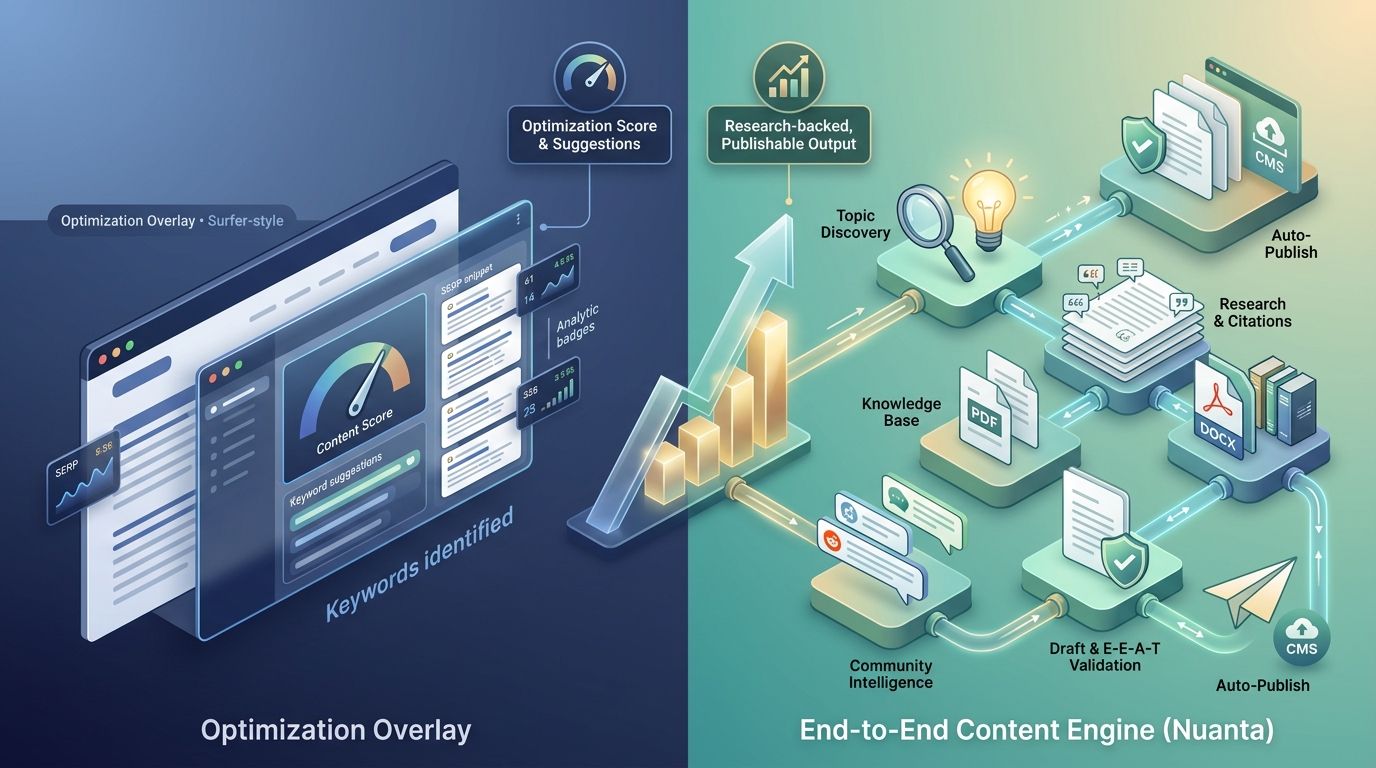
TL;DR. We compared 9 AI SEO content tools across 52 features. No single tool covers the whole workflow. Leaders cluster in three categories — signal-driven engines (Nuanta), content optimizers (Surfer, Frase, Clearscope), and all-in-one marketing platforms (Search Atlas, Jasper). The gap between a $49 and a $399 plan is mostly seats and quotas, not capabilities. Pick by your bottleneck, not feature count.
When you're building a content tool, you end up studying every competitor obsessively. Their feature pages, pricing models, G2 reviews, the gaps users complain about on Reddit at 2am. This article is honestly the result of about three months of that research, turned into a feature-by-feature comparison of nine AI SEO content platforms across 52 capabilities.
Disclosure: we built one of these tools (Nuanta), so we have inherent bias. We've tried to compensate by being specific about where competitors genuinely outperform us, where our claims are unproven, and where the whole category has shared blind spots. You'll see us admit to gaps multiple times below. That's intentional.
The Nine Tools We Compared
| Tool | Starting Price | Primary Category |
|---|---|---|
| Nuanta | $49/mo | Signal-driven content engine |
| Frase | $49/mo | Research + optimization + AI agent |
| Search Atlas | $99/mo | All-in-one SEO suite (40+ tools) |
| Surfer SEO | $99/mo | Content optimization + scoring |
| Distribb | $97/mo | Autopilot content + backlink exchange |
| Jasper | $69/mo | Enterprise AI marketing platform |
| Clearscope | $129/mo | Premium NLP content grading |
| Byword | $99/mo | Bulk programmatic SEO |
| ContentBot | ~$30/mo | AI writing + workflow automation |
Content Discovery & Strategy
Before you write anything, you need to know what's worth writing about. This is where the tools diverge most sharply, and honestly where most of them just... don't show up.
| Feature | Nuanta | Distribb | Frase | Search Atlas | Surfer | Jasper | Clearscope | Byword | ContentBot |
|---|---|---|---|---|---|---|---|---|---|
| Keyword research | ✅ Signal Engine (5 sources) | ✅ | ✅ SERP analysis | ✅ Topical Maps | ✅ Topical Map | ❌ | ✅ | ❌ | ❌ |
| Community signal listening | ✅ Reddit, forums, Quora | ❌ | ❌ | ❌ | ❌ | ❌ | ❌ | ❌ | ❌ |
| Google Search Console | ✅ | ❌ | ✅ GSC alerts | ✅ | ❌ | ❌ | ✅ | ❌ | ❌ |
| Competitor content gaps | ✅ | ✅ | ✅ | ✅ | ✅ | ❌ | ✅ | ❌ | ❌ |
| Topic clustering | ✅ | ❌ | ✅ Visual maps | ✅ | ✅ | ❌ | ❌ | ❌ | ❌ |
| Content calendar | ✅ | ✅ 30-day rolling | 🟡 | ✅ | ❌ | ✅ | ❌ | ❌ | ✅ |
What stands out: Most tools assume you arrive with keywords already chosen. Only Nuanta, Frase, and Search Atlas actively help you decide what to write about. Nuanta's community signal listening (Reddit, forums, Quora) is unique in this group because nobody else pulls real-time audience questions from these sources to surface content opportunities.
Honest gap: Jasper, Byword, and ContentBot offer zero topic discovery. If you use them, you need a separate keyword research tool. That's fine if you already have one, but it's worth knowing upfront.
Content Generation
This is the category everyone cares about most. It's also where marketing claims diverge furthest from reality.
| Feature | Nuanta | Distribb | Frase | Search Atlas | Surfer | Jasper | Clearscope | Byword | ContentBot |
|---|---|---|---|---|---|---|---|---|---|
| AI article writer | ✅ Full pipeline | ✅ 4,500+ words | ✅ Long-form | ✅ Content Genius | ✅ Surfer AI | ✅ Unlimited | 🟡 Drafting assist | ✅ Bulk gen | ✅ |
| Deep research with citations | ✅ Multi-step Factbook | 🟡 | 🟡 SERP-based | ❌ | ❌ | ❌ | ❌ | ❌ | ❌ |
| Voice notes → Knowledge Base | ✅ | ❌ | ❌ | ❌ | ❌ | ❌ | ❌ | ❌ | ❌ |
| Custom Knowledge Base | ✅ PDFs, Docs, URLs | ❌ | ❌ | ❌ | ✅ | ✅ Jasper IQ | ❌ | ❌ | ❌ |
| Brand voice training | ✅ | ✅ | ✅ Governance | ❌ | ✅ | ✅ 5–30 samples | ❌ | ❌ | ❌ |
| Internal linking | ✅ Auto | ✅ | ✅ | ❌ | ✅ | ❌ | ❌ | ✅ | 🟡 |
| Bulk generation | ✅ Batches | ✅ | ✅ 100+ (pSEO) | ✅ | ❌ | ✅ | ❌ | ✅ 1,000+ | ✅ |
| Multi-language | ✅ 29 | ✅ 150+ | ✅ | ✅ | ✅ 11 | ✅ 30+ | ❌ | ✅ 10 | ✅ 110+ |
What "AI article writer" actually means varies wildly
Every tool on this list claims AI article writing, but the depth of the pipeline behind that claim is radically different:
- Byword and ContentBot generate articles from a keyword with minimal research. Fast, cheap, shallow. That's not a judgment, it's just what they're designed for.
- Surfer and Jasper write articles using their AI models but without a dedicated research step. Surfer layers NLP scoring on top, which helps.
- Frase researches SERPs before writing, which gives better topical coverage but is limited to what's already ranking. It can't surface things that nobody's written about yet.
- Nuanta runs a multi-step deep research engine that compiles a cited Factbook before writing begins. Claims in the final article trace back to sources.
- Distribb claims "original cited research" but doesn't expose a Factbook or research document that users can inspect. So it's hard to evaluate.
Knowledge Base: the underrated differentiator
Only three tools let you upload your organization's proprietary knowledge and inject it into content: Nuanta (PDFs, Docs, URLs, voice transcription), Surfer (Custom Knowledge), and Jasper (Jasper IQ). Everyone else writes from public web data only, which means your articles read like everyone else's articles. That's the core problem.
Nuanta is the only tool with voice-to-text for the Knowledge Base. Record a subject matter expert explaining a concept for 15 minutes, and the transcription gets structured into KB documents for article enrichment. The feature exists because getting SMEs to write is basically impossible, but getting them to talk is easy.
Content Optimization & Quality
The scoring wars. Every tool wants to tell you their content score is the one that matters.
| Feature | Nuanta | Distribb | Frase | Search Atlas | Surfer | Jasper | Clearscope | Byword | ContentBot |
|---|---|---|---|---|---|---|---|---|---|
| SEO content score | ✅ E-E-A-T quality score | 🟡 | ✅ SEO + GEO score | ✅ Content Score | ✅ Content Score | ❌ | ✅ Grade A++ to F | ❌ | ❌ |
| Real-time optimization | ✅ | ❌ | ✅ | ✅ | ✅ | ❌ | ✅ | ❌ | ❌ |
| GEO / AI search optimization | 🟡 | ❌ | ✅ | ❌ | 🟡 | ❌ | ✅ AEO | ❌ | ❌ |
| Content audit / refresh | ❌ | ❌ | ✅ Decay detection | ✅ | ✅ | ❌ | ✅ | ❌ | ❌ |
| E-E-A-T scoring | ✅ Per-article | 🟡 Claims only | ✅ Per-page | ❌ | 🟡 | ❌ | ❌ | ❌ | ❌ |
Two fundamentally different scoring philosophies
NLP-based scoring (Surfer, Clearscope, Frase): analyzes what's already ranking and tells you how to match those patterns. Effective for on-page optimization but doesn't evaluate whether your content demonstrates genuine expertise.
E-E-A-T-based scoring (Nuanta, Frase): evaluates whether content shows Experience, Expertise, Authoritativeness, and Trustworthiness. Nuanta gates the entire pipeline on E-E-A-T thresholds, so articles that fail don't auto-publish.
Neither approach guarantees rankings. But they optimize for different things. Understanding which one matters for your use case is honestly more important than the score number itself.
Nuanta's honest gap: content audit
Nuanta doesn't have content audit or refresh capabilities yet. Surfer, Frase, Clearscope, and Search Atlas all offer tools to identify declining content that needs updating. If you manage a large existing content library, this is a meaningful missing feature. It's on the roadmap.
Publishing & Distribution
Getting content from "done" to "live" without manual copy-paste. This part is more boring to talk about but honestly it's where a lot of time gets wasted in practice.
| Feature | Nuanta | Distribb | Frase | Search Atlas | Surfer | Jasper | Clearscope | Byword | ContentBot |
|---|---|---|---|---|---|---|---|---|---|
| Auto-publish to CMS | ✅ 13+ integrations | ✅ 9 CMS platforms | ✅ WP, Webflow, Sanity | ✅ | ❌ Export only | ❌ | ❌ | ✅ WP, Ghost, Shopify, HubSpot | ✅ WP + Webhooks |
| Publish scheduling | ✅ | ✅ | 🟡 | ✅ | ❌ | ❌ | ❌ | ❌ | ✅ |
| Review before publish | ✅ Configurable window | ✅ | ❌ | ❌ | ❌ | ✅ | ❌ | ❌ | ❌ |
| Social media distribution | 🟡 | ✅ LinkedIn, X, IG, FB, Reddit | ✅ Content Atomization | ❌ | ❌ | ✅ | ❌ | ❌ | ❌ |
Distribb leads on distribution. Their auto-posting to five social platforms (LinkedIn, X, Instagram, Facebook, Reddit) is a genuine workflow advantage that Nuanta can't match right now. Frase's Content Atomization, automatically repurposing articles into social posts, email copy, and video scripts, is similarly strong.
Surfer and Clearscope don't publish at all. They're optimization layers, not production systems. You need a separate tool or manual workflow to get content live.
Link Building & Authority
The elephant in every content tool's room. Most of them just pretend backlinks don't exist.
| Feature | Nuanta | Distribb | Frase | Search Atlas | Everyone Else |
|---|---|---|---|---|---|
| Backlink exchange | ❌ | ✅ Automated contextual | ❌ | ❌ | ❌ |
| Link building outreach | ❌ | ❌ | ❌ | ✅ | ❌ |
| Backlink analysis | ❌ | ❌ | ❌ | ✅ | ❌ |
Distribb's backlink exchange network is their primary moat. No other content tool offers automated contextual backlink building. Whether the link quality holds up over time, honestly, remains to be seen. But the concept addresses a real gap in the market.
Search Atlas is the only tool with traditional link building features (outreach, analysis, press releases). This reflects their "all-in-one SEO suite" positioning.
Everyone else (including Nuanta) assumes you handle backlinks separately. For most teams, that means Ahrefs, Semrush, or manual outreach.
AI Search Tracking
The newest battleground: are you visible in ChatGPT, Gemini, and Perplexity?
| Feature | Frase | Clearscope | Surfer | Search Atlas | Everyone Else |
|---|---|---|---|---|---|
| AI search visibility | ✅ 8 AI platforms | ✅ Prompt tracking | ✅ AI Tracker | ✅ LLM Visibility | ❌ |
| AI citation monitoring | ✅ Share-of-voice | ✅ Brand mentions | ✅ Visibility Score | ✅ | ❌ |
Nuanta doesn't have AI search tracking yet. This is a growing buyer concern. "Am I being cited by ChatGPT?" Frase, Clearscope, Surfer, and Search Atlas all address it. It's on the roadmap but honestly it's not built yet.
One caveat worth flagging. Tracking visibility is one problem; producing content that earns those citations is another. The peer-reviewed GEO study by Aggarwal et al. (Princeton/Cornell, KDD 2024), measured across 10,000 queries, found that the highest-impact tactics for AI-engine citation are quoted experts (+41%), original statistics with citations (+30%), and external source citations (+30%) — while keyword stuffing actively decreases visibility by 9%. None of the tracking tools listed above measure that input side directly. They tell you what is happening; the research tells you why. A tracking dashboard without a content engine that produces citation-friendly drafts is a thermometer without a furnace.
The Feature Count Reality Check
Raw feature counts across all 52 capabilities audited:
| Rank | Tool | Features (of 52) | Best At |
|---|---|---|---|
| 1 | Search Atlas | 32 | Broadest toolset (40+ tools including technical SEO) |
| 2 | Frase | 31 | Most complete content platform (agent + GEO + atomization) |
| 3 | Nuanta | 25 | Signal Engine + deep research + E-E-A-T (unique differentiators) |
| 3 | Distribb | 24 | Autopilot + backlink exchange (unique moat) |
| 5 | Surfer SEO | 21 | Content Score optimization (industry standard) |
| 6 | Jasper | 14 | Enterprise marketing workflows |
| 7 | ContentBot | 13 | Workflow automation (AI Flows) |
| 8 | Clearscope | 13 | Premium NLP grading (narrow but deep) |
| 9 | Byword | 6 | Bulk programmatic SEO (single-purpose) |
Feature count doesn't equal quality. Search Atlas has the most features but honestly many are shallow implementations. Clearscope has only 13 features but its NLP grading is best-in-class for the specific problem it solves. The right question isn't "who has the most features" but "which features solve your bottleneck." Teams pick Byword (6 features) over Search Atlas (32 features) all the time because bulk programmatic SEO was the one thing they needed.
What Makes Each Tool Unique
Every tool has at least one capability nobody else matches:
| Tool | Unique Capability | Why It Matters |
|---|---|---|
| Nuanta | Signal Engine (5-source topic discovery including Reddit/forums) + Voice Notes → KB | Content based on real audience questions + proprietary expertise |
| Distribb | Automated contextual backlink exchange network | Addresses the link-building gap every other content tool ignores |
| Frase | Content Atomization (auto-repurpose to 5+ formats) + 80-skill AI agent | One article becomes social posts, emails, video scripts automatically |
| Search Atlas | OTTO SEO (1-click technical SEO automation) + 30+ schema types | Technical SEO automation nobody else attempts |
| Surfer | Content Score as industry standard + Keyword Surfer Chrome extension | The optimization benchmark everyone competes against |
| Jasper | Jasper IQ brand training (5–30 sample deep learning) | Enterprise-grade brand voice consistency |
| Clearscope | Grade A++ to F content grading with AEO optimization | Premium quality scoring with AI search optimization |
| Byword | 1,000+ pages per batch programmatic SEO | Pure volume play for directory and template sites |
| ContentBot | Visual AI Flows (no-code workflow builder) | Chain multiple AI tasks into automated sequences |
Pricing Reality: Cost Per Article
Raw monthly prices are misleading because the unit of output differs. Some tools give you optimization reports, others give you finished articles. Here's the cost per complete AI-generated article when you do the math:
| Tool | Plan | Price | Articles | $/Article |
|---|---|---|---|---|
| Distribb | Pro | $97/mo | 30 | $3.23 |
| Frase | Scale | $299/mo | 100 | $2.99 |
| Nuanta | Publisher | $199/mo | 50 | $3.98 |
| Search Atlas | Starter | $99/mo | 30 | $3.30 |
| Byword | Standard | $299/mo | 80 | $3.74 |
| Nuanta | Writer | $99/mo | 15 | $6.60 |
| Nuanta | Solo | $49/mo | 5 | $9.80 |
| Surfer | Essential | $99/mo | 5 AI articles | $19.80 |
| Clearscope | Essentials | $129/mo | 20 reports | $6.45 (optimization only) |
Important distinction: Surfer and Clearscope prices reflect optimization reports, not complete articles. Comparing their per-unit cost to tools that generate full articles is misleading. They're solving a different problem at a different price point.
What No Tool Solves
Shared limitations across the entire category. Nobody has figured these out yet:
- Technical SEO audits and site speed: only Search Atlas and Frase touch this. Everyone else assumes you use Ahrefs, Semrush, or Screaming Frog.
- Backlink acquisition at scale: only Distribb (exchange) and Search Atlas (outreach) address link building. The rest leave this to dedicated tools.
- Guaranteed rankings: no tool can promise this. Content quality is one factor among domain authority, backlinks, technical health, and competition. Anyone who tells you otherwise is lying.
- Replacing human editorial judgment: every tool benefits from a human editor reviewing for brand voice, factual accuracy, and nuanced arguments before publishing. Even ours.
How to Choose: Decision Framework
Choose based on your bottleneck, not feature count.
Your bottleneck is "what to write about": → Nuanta (Signal Engine), Frase (Content Opportunities), or Search Atlas (Topical Maps)
Your bottleneck is "optimizing existing content": → Surfer SEO (Content Score), Clearscope (Grade system), or Frase (real-time analysis)
Your bottleneck is "producing articles without writers": → Nuanta (full pipeline with research), Distribb (autopilot), or Byword (bulk generation)
Your bottleneck is "getting content published and distributed": → Distribb (5-platform social + CMS), Nuanta (13+ integrations), or Frase (Content Atomization)
Your bottleneck is "enterprise brand consistency": → Jasper (IQ brand training + campaigns), Surfer (brand voice + Content Score)
Your bottleneck is "technical SEO + content in one place": → Search Atlas (OTTO + 40 tools) is honestly the only real option here.
Nuanta's Position
Nuanta exists because the full content workflow (topic discovery → research → writing → publishing) used to require four separate tools. The pipeline handles that entire sequence in one place.
What Nuanta does that nobody else does:
- Signal Engine pulling from 5 sources including Reddit and forums
- Deep research with cited Factbook before writing begins
- Voice Notes → Knowledge Base for SME input
- E-E-A-T quality scoring with pass/fail gates
Honest gaps:
- No AI search tracking (yet)
- No backlink tools
- No content audit/refresh
If those gaps matter more than the strengths for your workflow, pick the tool that fits. The decision framework above should help.
Frequently asked questions
Which AI SEO tool is best for small teams?
For solo founders and 2–5 person teams, the cost-per-article math usually decides it. Byword wins on pure bulk programmatic at $39/mo. Nuanta wins if you want signal-driven topic selection + deep research in one $49/mo plan. Surfer's $49 Discovery plan trades research depth for a polished Content Score editor. Pick by which bottleneck — research, optimization, or volume — actually slows you down today.
What's the practical difference between Surfer and Frase?
Surfer leads with Content Score — a SERP-NLP grade you optimize against in a clean editor. Frase leads with an AI Agent + Factbook approach that produces drafts grounded in research. Surfer is sharper if your bottleneck is on-page optimization of existing drafts. Frase is sharper if your bottleneck is going from keyword to first draft. Both ship AI visibility tracking; both are mature.
Do AI SEO tools actually help my content rank in AI Overviews?
Indirectly. Tools that produce well-cited, fact-dense, schema-equipped articles correlate with AI Overview citations because AI engines weight extractability and citation density. The KDD 2024 GEO study showed +30–41% citation lift from statistics, quotes, and external citations. The tools listed above vary widely on how aggressively they enforce those signals at draft time.
How much should I pay for an AI SEO tool?
For most teams the right band is $49–$199/mo. Below $49 you get a polished single-purpose tool (Byword, Surfer Discovery). $99–$199 is where serious content workflows live (Nuanta Writer, Frase Pro, Search Atlas Growth). Above $300/mo you're paying for seats, agency-scale quotas, or enterprise contracts. Cost-per-article matters more than sticker price — at $99 / 15 articles, you're at $6.60 per draft.
Is there a free AI SEO tool worth using?
Nothing free covers the full workflow. The most useful free tier in the list is Surfer's free AI Detector and Humanizer pair, which is a top-of-funnel lead magnet, not a production content tool. For trial evaluation, every paid tool here ships a 3- to 7-day free trial — that's the right way to compare them on your actual keyword.
 Try It Yourself
The best way to evaluate any tool on this list is to run your own keyword through it and compare the output. We offer a 7-day free trial with full access to the Signal Engine, deep research with cited Factbook, E-E-A-T scoring, and auto-publish to your CMS.
If Nuanta isn't the right fit, the decision framework above should help you find the tool that is. Every platform on this list offers a trial or demo. Use them.
Start Free Trial →Methodology
- All feature data sourced from official product pages, verified against third-party reviews (G2, TechRadar, Capterra) as of April 2026.
- Pricing reflects published monthly rates; annual billing discounts not included.
- Feature availability marked as ✅ (available), 🟡 (partial/limited), or ❌ (not available) based on public documentation.
- Products with inaccessible feature pages (Jasper, Clearscope, ContentBot returned 404/403) were evaluated using third-party review data.