Why AI Answer Engines Cite Some SaaS Pages and Ignore Others
This guide is a nine-step, page-level rewrite workflow for making SaaS pages answer-first so ChatGPT, Perplexity, and Google AI Overviews can extract and cite them. The system breaks down into three phases: first, you pick the right pages; then, for the nine structural changes, you add a direct answer block, use question-based H2s, include comparison tables, tighten paragraphs, add schema, add freshness signals, verify claims, define a six-element extractable-answer spec, and add authority signals; and then you run a post-publish QA loop that re-tests citation pickup monthly. The rest of this article is the numbered breakdown of each step.
The problem this solves is specific. Your best SaaS page ranks on page one of Google and answers the exact question buyers type into ChatGPT, yet when you run that same question through ChatGPT, Perplexity, or Google's AI Overviews, a competitor gets named and you do not appear. The content is there, the answer is on the page, but the answer engine walks past it. The measurable cost is a lost brand inclusion rate: every buyer who asks an AI assistant for a shortlist and never sees your name is a citation you did not earn on a prompt you should own. Your Google rank stays flat while your appearance rate in AI answers stays at zero.
Answer-first structure means organizing a page so the direct answer to a specific question sits at the top of each section, written to be readable and extractable on its own. We use the term to describe a way of writing pages, separate from the answering-service company called AnswerFirst; this playbook covers on-page rewrites aimed at ChatGPT, Perplexity, and Google AI Overviews.
The reason structure matters comes down to how these systems retrieve. They do not read a page top to bottom the way a person does. They chunk the page into passages, embed those passages as vectors, and attach citations to individual sections rather than the whole document. A citation gets stapled to the specific passage that answered the query, which means every H2 has to be independently citable. A brilliant answer buried in paragraph nine loses to a mediocre one in the opening section, because the opening section is the passage that got retrieved.
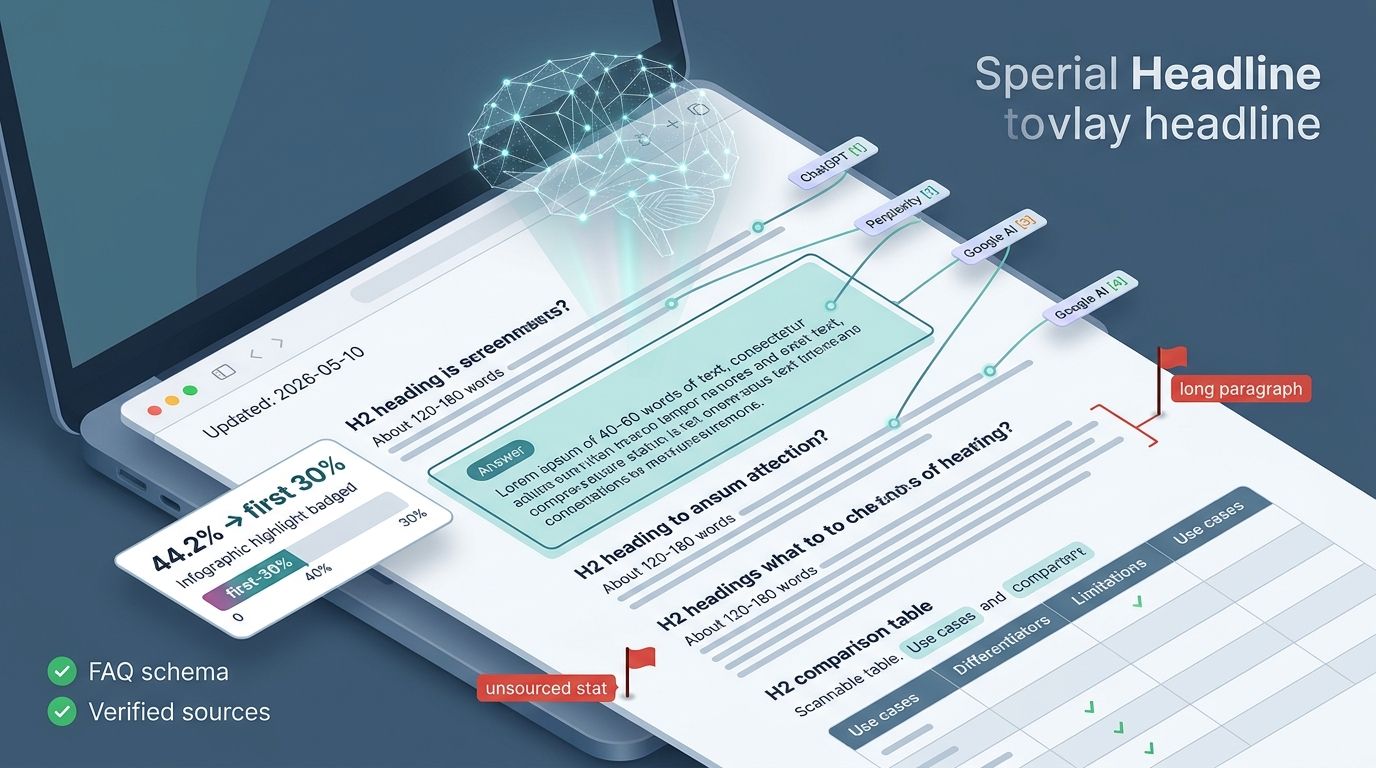
One data point anchors this entire playbook: in Kevin Indig's analysis of 1.2 million ChatGPT answers, 44.2% of citations came from the first 30% of an article. Nearly half the citation weight lives in the opening third of the page. Everything below that first stretch competes for the remaining share.
The changes that move the needle are matters of structure rather than cosmetics. A joint study from Princeton, Georgia Tech, and the Allen Institute for AI across 10,000 queries found that structural rewrites drove roughly 40% GEO visibility lift, while cosmetic rewriting (swapping synonyms, tightening a sentence here and there) delivered under 5%. Reformatting how the answer is presented beats rephrasing what it says.
What this playbook promises and what it does not: applying these nine changes improves extractability and citability, meaning your content becomes easier to retrieve, parse, and quote. No single edit guarantees a citation or a featured snippet. Retrieval and citation are probabilistic, model-dependent, and volatile. We are raising the odds and removing the reasons a system skips you, not buying a placement.
Before You Rewrite: Pick the Right Pages First
Rewriting everything at once wastes the leverage. We score candidates in a fixed sequence so the pages with a provable gap get fixed first.
-
Export your ranking pages. Pull the pages that rank on page one of Google for queries with real buyer intent. These are your candidate pool because the topical authority already exists.
-
Test the matching AI prompts. For each candidate, take a query you rank for, run it through ChatGPT and Perplexity, and check whether your page gets cited.
-
Flag the non-cited pages as top priority. Where Google surfaces you and the answer engines do not, you have a page whose content is fine and whose structure is failing. That is the cleanest win, because only the presentation needs fixing.
-
Add secondary candidates: high traffic plus high bounce. Pages with meaningful organic traffic paired with high bounce rates go into the queue next (Umbrex). A high bounce rate on a page people found through search often signals the answer is hard to locate once they land, which is the same friction that keeps an answer engine from extracting a clean passage.
-
Prioritize by page type. We map each candidate against the type playbook before touching the copy:
| Page type | Primary rewrite priority | What to add first |
|---|---|---|
| Landing / homepage | Direct answer above the fold that defines what the product is and who it is for | 40-60 word answer block replacing hero marketing copy |
| Feature page | Question-based H2s that match real prompts about capability | One-question headings plus concrete, named specifications |
| Comparison / alternatives | Decision matrix covering fit, limitations, and ideal customer profile | Comparison table plus when-you-should-and-shouldn't-choose framing |
- Record a baseline. Before we edit a single line, we run the category prompts (for example, best AI writing tools for SaaS content teams) and the comparison prompts (for example, tool X vs tool Y for long-form content). For each one we note whether the brand appears at all and log which competitors get cited in its place. Save the raw output. Without this snapshot you have opinions about whether the rewrite worked; with it you have a before-and-after you can point to.
Change 1: Add a 40-60 Word Direct Answer Above the Fold
Place a self-contained answer block at the top of the page, immediately below the H1 and before any supporting narrative. Self-containment is the whole point: the block has to read cleanly and extract cleanly without the rest of the page around it, because that is exactly how a retrieval system will encounter it.
There is a word-count tension to resolve. The opening chunk that carries the direct answer should run 40 to 80 words, tight enough to be quoted whole (Kime). But the section it lives in should run 120 to 180 words total, because LLM Pulse found that sections in that range earned 70% more citations than shorter or longer ones. So we write a crisp 40-80 word answer, then follow it with a sentence or two of qualifying context that brings the full section into the 120-180 window without diluting the lead.
The test is five seconds. A reader who lands on the page should get the primary answer before scrolling. If they have to move past a hero image, a value-proposition slogan, and three feature icons to learn what the product actually does, the answer is buried and so is your citability.
Here is a homepage hero rewritten from marketing copy into a direct answer block.
Before:
Content that works as hard as you do.
Stop guessing. Start ranking. The all-in-one platform built for
teams who refuse to settle.
After:
Nuanta is an AI content platform for SaaS marketing teams that
researches, writes, optimizes, and auto-publishes long-form SEO
articles. It runs a full pipeline from a 5-source keyword engine
through E-E-A-T quality scoring to 13+ CMS integrations, so a
single brief becomes a published, research-backed article.
The rewrite names the category, the audience, the workflow, and the specifics in 55 words. A model reading that block knows what to cite it for. The slogan told a system nothing extractable.
Change 2: Convert Vague Sections Into One-Question H2 Headings
Every page has one primary question it exists to answer. Identify it first. On single-topic pages that primary question becomes the guiding frame; on multi-topic pages, assign one self-contained question to each major section, so each H2 maps to a distinct thing a person might actually ask.
Non-question headings are a costly default. In PingPrime's audits, non-question H2s were one of five errors that appeared in 80% of pages reviewed (PingPrime). A heading like "Powerful Features" or "Our Approach" gives a retrieval system no query to match against, so the section underneath never gets connected to a prompt.
The mechanism to exploit is simple: a declarative answer placed directly under a heading that mirrors the question becomes a high-confidence extraction candidate. When the heading asks the question and the first sentence answers it in plain terms, the system has a matched question-and-answer pair sitting in one passage, which is precisely the shape it wants to cite.
A feature-page rewrite makes the difference concrete.
Before:
## Intelligent AutomationAfter:
## Can I publish SEO articles automatically without touching a CMS?The generic heading described an internal capability in our own language. The question version matches the phrasing a buyer would type, and the paragraph beneath it can now open with a direct answer: yes, the pipeline auto-publishes to 13+ CMS integrations from a single brief.
Change 3: Insert Comparison Tables and Decision Matrices
Comparison pages carry high commercial intent, and a table is the format an answer engine can parse cleanest. For a SaaS comparison table, include columns that let a buyer and a machine reach a decision:
- The category each option belongs to
- The primary use cases it fits
- Its genuine differentiators
- Its honest limitations
- The ideal customer profile
- The decision criteria that separate one choice from another
Comparison framing itself triggers retrieval. In Writesonic's test, prompts containing comparison framing triggered a web search 100% of the time, so pages built around explicit comparison are structurally aligned with how these queries get answered (Writesonic).
Go beyond the standard competitor-alternative keyword play. Ranking for "X alternative" gets you into the consideration, but the citable version explains when your product is a better fit and, just as importantly, when it is a worse one. A table that admits where a competitor wins reads as a trustworthy source, and trustworthy sources are the ones a model quotes on comparison queries.
Here is a prose comparison rebuilt as a decision table.
Before:
Frase is cheaper per article at $2.99 on its Scale plan and includes
research and optimization, but it doesn't auto-publish. Nuanta costs
$3.98 per article on Publisher but runs the full pipeline including
publishing, and it's better for teams because it bundles 50 seats.
After:
| Criterion | Frase (Scale) | Nuanta (Publisher) |
|---|---|---|
| Cheapest $/article | $2.99 | $3.98 |
| Research + optimization | ✅ | ✅ |
| Auto-publish to CMS | ❌ | ✅ 13+ integrations |
| Seats included | Not bundled at this tier | 50 seats |
| Best fit | Solo optimizer, manual publishing | Team publishing at volume |
Example values drawn from our internal competitive analysis (per-article pricing and feature comparison, current as of the analysis date). Treat these as an illustrative internal example; verify live pricing and seat counts against each vendor's current pricing page before publishing your own table.
The prose forces a reader to hold four variables in their head; the table lets a person, or a model, extract the exact row that answers "which is better for a publishing team at volume."
Change 4: Tighten Paragraphs and Increase Factual Density
Cap paragraphs at roughly 150 words. Long paragraphs are another of the five common audit errors, because a wall of text gives a retrieval system no clean boundary to chunk on, so the answer inside it gets diluted across an unwieldy passage.
The finding that surprises most teams is that cited content favors density over simplicity. Passionfruit's analysis found cited pages ran about 20.6% entity density, three to four times normal, and scored around Flesch-Kincaid grade 16 versus 19.1 for lower performers (Passionfruit Docs). Higher reading grade, more named entities per hundred words. Answer engines favor content that packs specific, verifiable facts, not content dumbed down to the shortest words.
Raising entity density is not keyword stuffing. We increase density when we name the actual tools, identify the named integrations, give the real numbers, and describe the concrete outcomes. Every proper noun and every figure you add is another entity a system can anchor a citation to.
A spec block shows the shift.
Before:
Our platform integrates with all your favorite tools and publishes
your content wherever you need it, fast.
After:
The pipeline auto-publishes to 13+ CMS integrations, scores every
draft against Google's E-E-A-T framework, and sources topics from a
5-source keyword Signal Engine. A single brief moves from research
to a published, internally linked article without a manual export.
The before sentence contains zero named entities. The after version names the integration count, the scoring framework, the source engine, and the workflow, giving a system four concrete facts to cite instead of an adjective.
Change 5: Add FAQ and Product Schema
Structured data tells a parser where your answers live (Google Search Central). Apply the schema type that matches the page:
- FAQ schema for pages with genuine question-and-answer pairs
- HowTo schema for step-by-step instructional content
- Article schema for blog and editorial content
- Product schema for product and pricing pages (marks up product name, description, features, and price so a parser can associate the page with a specific product entity)
Schema and answer-first formatting are two halves of one move. The formatting makes your answers clear to a human and a language model reading the rendered page; the schema signals to a parser exactly where each question-and-answer pair sits in the markup. One works on comprehension, the other on machine-readability, and they reinforce each other.
The honest limit is that schema aids parsing but does not guarantee snippet capture or citation. Google's own featured-snippet documentation makes no top-placement claim, and adding markup changes how easily your content is understood regardless of whether an engine chooses to feature it.
Here is the sequence we run to add FAQ schema to an existing SaaS page:
- Pull the real questions already answered on the page. Do not invent Q&A pairs that do not appear in the visible content.
- Match each schema question and answer word-for-word to the on-page text. Markup that misrepresents visible content can be misleading and should be avoided; keep the rendered text and the markup identical.
- Keep answers concise and factual, mirroring the 40-80 word answer blocks you built in Change 1.
- Add the JSON-LD block to the page
<head>or body. Use a placeholder structure like this:
{
  "@context": "https://schema.org",
  "@type": "FAQPage",
  "mainEntity": [{
    "@type": "Question",
    "name": "Can I publish SEO articles automatically without touching a CMS?",
    "acceptedAnswer": {
      "@type": "Answer",
      "text": "Yes. The pipeline auto-publishes to 13+ CMS integrations from a single brief."
    }
  }]
}- Validate the markup with a structured-data testing tool (Google's Rich Results Test or the Schema.org validator) before publishing, and confirm no errors or missing required fields.
- Never mark up content that is not visible to the user on the page.
For product and pricing pages, apply Product schema in parallel: mark up the product name, one-line description, key features, and the offer price so the pricing page resolves as a distinct product entity. Validate it with the same testing tools and keep the marked-up price identical to the visible price.
Change 6: Refresh Last-Updated Signals
Add a visible last-updated date to the page, shown to readers, not just buried in metadata. Omitting dates is one of the five common audit errors, and a page with no visible freshness signal gives an engine no reason to treat it as current.
The freshness evidence is real but varies sharply by model, so treat it as a lever with different weight in different tools. Discovered Labs found Perplexity favors content under 30 days old, citing it roughly 3.2 times more often (ChatReady). LLM Pulse reported that over 70% of AI-cited pages had been updated within 12 months. Ahrefs, analyzing 17 million citations, found model-level freshness bias shifts release to release, so the exact premium on recency moves as models update. The direction is consistent even when the magnitude is not: recent, dated content is easier to trust and easier to cite.
Draw a hard line between a genuine update and a cosmetic date change. Bumping the date without touching the content is the kind of signal that erodes trust and, once detected, works against you. A real update revises stale statistics, adds new sections, corrects claims, and refreshes examples. Log every real content revision (what changed and when) so your visible date reflects actual work, and so you have a record when you re-test citation pickup later.
Change 7: Verify Every Outbound Claim
Verification is where a differentiation angle hides in plain sight. A 2025 Nature Communications study found that 50 to 90% of LLM responses were not fully supported by their cited sources (Nature Communications). Answer engines are quoting sources that do not actually back the claim, which means being the clean, verifiable source is itself an advantage: a page whose every claim checks out is a safer citation for a model trying to avoid getting it wrong.
Unsourced statistics are one of the five common audit errors, and fixing them pays. AirOps' 2025 data attributed a 37% visibility lift to citations and a 22% lift to statistics. Named sources and hard numbers are among the strongest signals you can add.
We run a claim audit in this order:
- Locate every numeric or factual claim on the page (statistics, percentages, dated facts, named studies).
- Attach a named and linked source to each one, so the origin is transparent.
- Add a visible date to the claim or its source where recency matters.
- Remove or reword anything you cannot verify, rather than leaving an unsupported figure standing.
Anything that survives the audit is a claim a model can cite without inheriting your risk.
Change 8: Assemble the Six Elements of an Extractable Answer
The previous changes converge into one specification. PingPrime's extractable-answer spec has six elements, and a section that hits all six is as citable as you can make it: (PingPrime)
- A precise statistic rather than a vague quantity
- A named and linked source for that statistic
- A visible date on the claim or page
- A clear definition of the term or concept
- A question-and-answer structure, heading matched to answer
- A length of 40 to 80 words for the core answer chunk
Turn this into a reusable answer-block template your content team drops into every H2: open with the question as the heading, answer it in one direct sentence, cite the statistic with its named source and date inline, define any term on first use, and hold the core to 40-80 words before adding context.
A rebuilt H2 shows all six landing together.
Before:
## Freshness
Keeping content fresh helps with AI visibility. Updated pages tend
to do better.
After:
## Does updating a page improve its odds of being cited by AI?

Yes. Recently updated pages are cited more often: Discovered Labs
(2024) found Perplexity cites content under 30 days old about 3.2x
more than older pages, and LLM Pulse reported over 70% of AI-cited
pages were updated within the past 12 months. A visible last-updated
date is the signal that carries this weight.
The after version is a question heading, a direct one-word answer, two precise statistics with named and dated sources, a working definition of the freshness signal, and a 62-word core.
Change 9: Strengthen Entity and Third-Party Authority Signals
On the page itself, make authority explicit by ensuring that a real byline names the author, the company is clearly stated, and source credibility is visible inside the content rather than assumed. A model weighing whether to trust a passage reads these signals the way a human editor would.
On-page work is necessary but not sufficient, and the data is blunt about it. Passionfruit found that DR 60+ domains dominate citations (Passionfruit). Review profiles on G2, Capterra, and Trustpilot raise citation probability roughly 3x. LLM Pulse observed that multi-publication distribution can lift citations up to 325%. None of that lives on the page you are rewriting; it lives across the web and on third-party platforms.
For branded queries the split is stark. Omniscient Digital, analyzing 23,387 citations, found only 5.4% of citations went to thought-leadership content, while reviews, listicles, and case studies dominated. So pair every rewrite with off-site presence, because the page is one input among several the engine weighs.
Concrete next actions to build the consistency these systems reward:
- Keep your product name, category, and one-line description identical across your website, docs, and blog so the entity resolves cleanly.
- Claim and populate your G2, Capterra, and Trustpilot profiles, and keep review volume moving.
- Pursue mentions and comparisons across multiple third-party publications rather than a single owned blog.
- Publish and maintain case studies and listicle-style resources, since those formats draw disproportionate citation weight on branded queries.
The Answer-First QA Checklist for Post-Publish Validation
Once a page is republished, we run it through a strict five-step post-publish workflow before calling it done.
-
Structural QA. Confirm that every H2 opens with a self-contained 40-80 word answer, that sections land in the 120-180 word range, that no paragraph exceeds 150 words, that headings are phrased as questions, that a last-updated date is visible, and that every statistic carries a named source.
-
Schema validation. Re-run the FAQ and Product markup through a structured-data testing tool, confirm zero errors, and verify every marked-up question, answer, and price matches the visible content word-for-word.
-
Rerun the fixed prompt set. Use the exact same category and comparison prompts you ran at baseline, and check whether your brand now appears. Holding the prompt set fixed means any change you see is attributable to the rewrite rather than a different question.
-
Compare competitor citations. Note which competitors still get cited on the same prompts and whether the rewrite displaced any of them.
-
Log the monthly trend. Record the run against your baseline snapshot so you have a longitudinal record rather than a single reading.
Track the metrics that reflect answer-engine reality rather than rankings alone:
- Brand inclusion rate: how often your brand appears in AI answers across your prompt set
- Citation frequency: how often your specific pages get cited
- AI-driven traffic: referral traffic arriving from AI tools
- Competitor citation frequency: how often rivals appear on the same prompts
This measurement has to repeat because citation is unstable. Reporting across the field shows 40 to 60% of cited sources rotate monthly, and only about 30% of cited brands persist run-to-run. A single passing test tells you almost nothing; a monthly re-test across a fixed prompt set tells you the trend. Treat measurement as longitudinal, not one-time.
The Common Mistakes That Keep SaaS Pages Out of AI Answers
Five errors show up in 80% of the pages PingPrime audited, and they are the same five this playbook has been dismantling: answers buried below marketing copy, statistics with no source, H2s that are not questions, paragraphs over 150 words, and missing visible dates. Fix those five and you have addressed the bulk of what keeps pages uncited.
The finding underneath them reframes the problem: 68% of brand content was not extractable despite covering the topic. The information was on the page. The presentation was not. The failure is a structural issue rather than a content gap, which is why rewriting the existing page usually beats writing a new one.
When you report results internally, avoid overclaiming. Separate strong evidence (controlled studies across large query sets) from vendor benchmarks and anecdotal wins, and label each accordingly. Set expectations that citation volume is volatile, that a page cited this month may drop next month, and that the honest read is a probability shift over time rather than a guaranteed placement. Managing that expectation upfront protects the credibility of the whole program.
What to Rewrite First This Week
If you do one thing before touching anything else, rewrite the first 80 words of each H2 to open with a direct, inline, sourced answer, because that opening answer was the strongest lever PingPrime observed across its field audits. It combines the buried-answer fix, the sourcing fix, and the length target into a single edit, and it lands in the opening third of the page where nearly half of all citation weight sits.
Sequence a two-week rollout across your five worst-performing commercial pages. In the first week, take your two highest-intent comparison and landing pages, rewrite every H2 opening to a sourced 40-80 word answer, add or clean up a decision table, and set a visible last-updated date. In the second week, move to your three remaining feature pages, converting vague headings to questions, tightening spec blocks with named entities, and running the outbound-claim audit on each. This keeps the sequence aligned to the landing, feature, and comparison page types in the playbook table. Republish as you go and log every revision so the freshness signal reflects real work.
Then watch one metric. Track brand citation frequency across a fixed prompt set and re-test it monthly rather than once, because a rewrite that appears to fail in week one and succeeds in month two is telling you something a single test would have hidden. The rank you already earned in Google is not the number that matters here; the number that matters is how often, across a stable set of questions, an answer engine now names you instead of the competitor it used to.