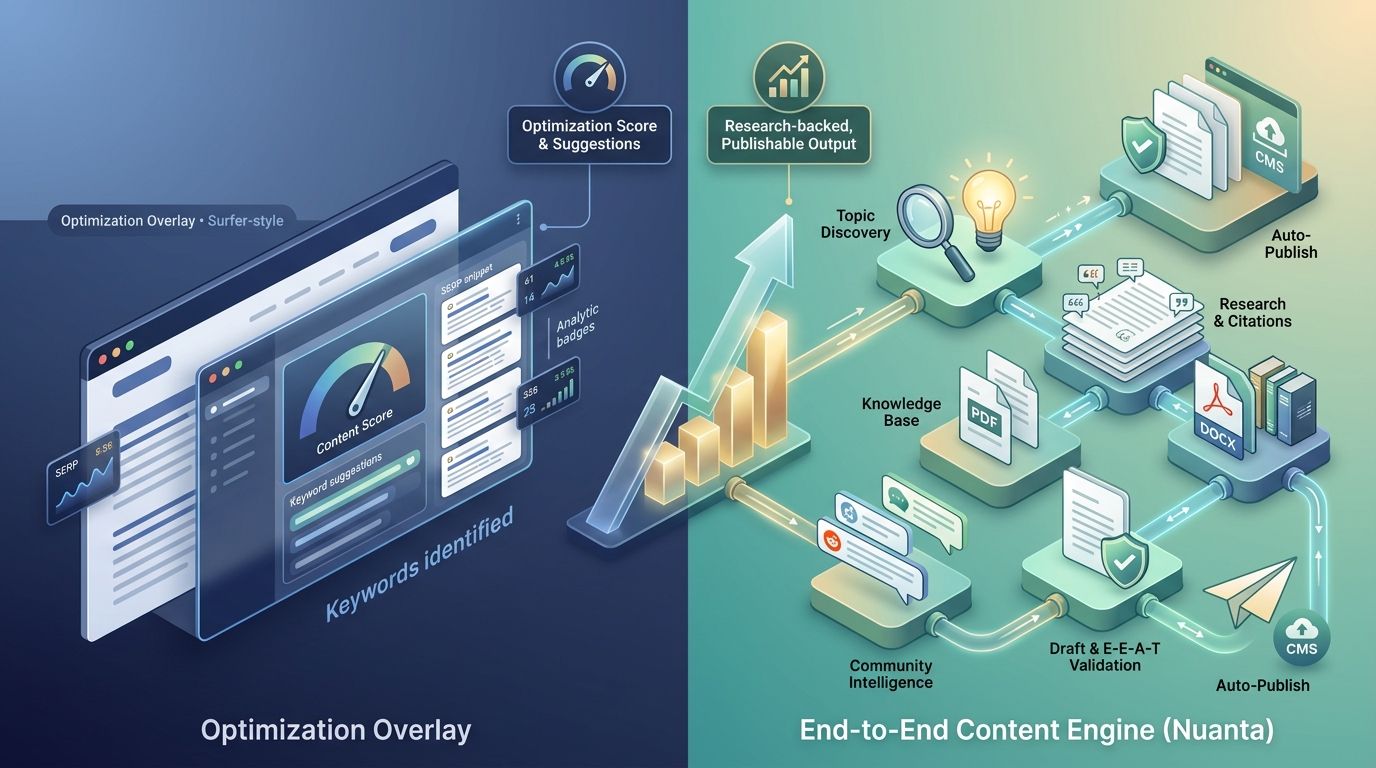
TL;DR. AI humanizers fail because detectors analyze how text was generated — statistical fingerprints like perplexity, burstiness, and embedding clusters — not how it reads. Swapping synonyms or reordering sentences doesn't move those signals. The durable answer is research-grounded content with real E-E-A-T validation, not surface paraphrasing.
The Promise of AI Humanizers and Why the Market Gets It Wrong
"AI humanizer" pulls in roughly 673,000 monthly searches. That's not a niche interest. That's a stampede. But dig into the data and the picture shifts: the cost-per-click sits at just $2.32 with low competition, signaling massive curiosity traffic but remarkably low purchase intent. People are searching, but they're not buying, because most of them are looking for a quick fix, not a real solution. It's telling that one of the savviest players in the SEO space uses a free AI humanizer purely as a lead-generation magnet, not as a core product feature. The tool exists to capture traffic, not to solve the underlying problem.
And behind every one of those searches is someone staring at a block of AI-generated text, wondering how to make it pass a detection scan before a deadline, a client review, or a classroom submission.
The pitch from humanizer vendors is simple: paste your AI text in, get human-sounding text out, and no detector will know the difference. Compelling. Clean. And it fundamentally misunderstands the problem.
The core misconception is this: people believe the issue is how AI text sounds. That if you swap enough words and shuffle enough sentences, the text will read as human. But modern AI detectors don't care much about how text sounds on the surface. They analyze how it was generated: the statistical fingerprints left behind by the probability distributions that large language models use to pick every single word. That's a much deeper problem than "replace 'utilize' with 'use.'"
Meanwhile, the detection ecosystem keeps growing. As of late 2025, 43% of U.S. teachers in grades 6–12 report using AI detection tools in their classrooms. Turnitin is embedded across institutional education. GPTZero has become a household name in education. The people who care about whether text is AI-generated aren't checking manually anymore. They have automated systems doing the checking for them, and those systems are getting smarter with every passing quarter.
What AI Humanizers Actually Do to Your Text
Strip away the marketing language, and what humanizers actually perform on your content falls into a short list of mechanical operations.
Synonym swapping and paraphrasing is the bread and butter. The tool scans each sentence, identifies words that can be replaced with alternatives, and makes substitutions. "Significant" becomes "considerable." "Implement" becomes "carry out." The sentence skeleton (its syntax, its rhythm, its structure) stays intact. In practice, many of these tools function as expensive thesauruses: they swap words without restructuring sentences or varying rhythm in ways that mirror natural human writing patterns.
Sentence reordering is the second trick. Paragraphs get reshuffled so that point B appears before point A. The information sequence changes, but the actual statistical structure of the writing (how predictable each word is given its neighbors) remains largely the same.
Filler and padding injection is perhaps the most noticeable operation. Transitional phrases get wedged in: "it's worth noting that," "interestingly enough," "to put it another way." Hedging language appears. The text gets longer, but not more meaningful.
All of these are surface-level operations. They change the skin of the text without touching the bones. And the bones are exactly what detectors are looking at.
Why AI Detectors See Through Humanized Text
Understanding why humanizers fail requires understanding what detectors actually measure. It's not a single signal. It's a constellation of them. Each one exposes a different layer of AI authorship that surface rewriting can't reach.
The table below summarizes the key signals and why humanizer techniques leave them largely unchanged:
| Detection Signal | Human Writing Range | AI-Generated Range | Why Humanizers Don't Move the Needle |
|---|---|---|---|
| Perplexity (word unpredictability) | ~80–100 units | ~20–30 units | Synonym swaps stay within the AI's probability distribution; both the original and replacement word are "expected" choices |
| Burstiness (sentence-level variation) | ~0.6–1.2 | ~0.2–0.4 | Reordering sentences doesn't change each sentence's internal uniformity; AI's signature evenness persists |
| Stylometric fingerprints | Idiosyncratic per writer | Consistent per model family | Function-word ratios, punctuation frequency, and syntactic preferences operate at the structural level; synonym swaps don't touch them |
| Embedding similarity | Distributed across semantic space | Clusters in AI-typical regions | Surface rewording barely shifts the high-dimensional semantic vector; meaning stays in the same neighborhood |
Perplexity measures how "surprised" a language model is by a given piece of text (essentially, how predictable the word choices are). Human writing scores high because humans make unexpected lexical choices, take detours, and use words in idiosyncratic ways. AI-generated text lands much lower because language models are fundamentally designed to pick the most probable next word. When a humanizer swaps "significant" for "considerable," both words sit comfortably within the AI's probability distribution. The perplexity barely moves. The swap is like rearranging deck chairs on a very predictable ship.
Burstiness captures how human writing naturally fluctuates in complexity: a short, punchy sentence followed by a long, winding one. Some paragraphs are dense with technical terms; others are conversational. AI-generated text is remarkably uniform. Reordering sentences within a paragraph doesn't change the fact that each sentence was constructed with the same uniform rhythm. The individual sentences still carry the AI's signature evenness.
Stylometric fingerprints go deeper still. Every writer (human or machine) has measurable patterns in function-word ratios (how often "the," "of," "and" appear), punctuation frequency, and syntactic preferences. These patterns are robust against synonym swapping because they operate at the structural level. Replacing a noun with its synonym doesn't change how often the text uses semicolons, or its ratio of dependent to independent clauses, or its tendency to front-load adverbial phrases. Paraphrasing preserves these fingerprints almost entirely.
Embedding similarity adds another dimension. Modern detectors convert text into high-dimensional semantic vectors and check where those vectors land in the embedding space. AI-generated text clusters in recognizable regions because language models share training data and optimization objectives. Surface rewording (changing individual words while keeping the same meaning) barely shifts the semantic vector. The text still lands in the AI-typical neighborhood.
Ensemble detection is what ties it all together. Major detection platforms don't rely on a single metric. They run multiple analyses simultaneously and combine the results through multi-signal architectures specifically designed to resist paraphrasing techniques. This means that even if a humanizer manages to shift one signal (say, slightly raising perplexity), it may simultaneously worsen another signal, like making burstiness even more uniform through its mechanical rewriting process. Fooling an ensemble of signals simultaneously is an exponentially harder problem than fooling any single one.
The Arms Race Detectors Are Winning
There's a structural asymmetry in this contest, and it doesn't favor the humanizers.
Detection platforms retrain their models on humanizer outputs as soon as those outputs appear in the wild. Turnitin, GPTZero, and institutional tools have dedicated research teams and continuous update cycles. When a new humanizer technique gains popularity, the outputs flood classrooms and content platforms, giving detectors abundant training data for that exact pattern. The window between a new evasion technique and the detector's adaptation to it keeps shrinking.
Multi-signal architecture means that a humanizer can't focus on gaming one metric. It needs to simultaneously fool perplexity analysis, burstiness measurement, stylometric profiling, embedding comparison, and whatever new signals the detector added last month. Each signal requires a different kind of text transformation, and transformations that help with one signal can actively hurt another.
There's also an emerging category of defense that humanizers fundamentally can't address: watermarking at the token-generation level. Some AI providers are experimenting with embedding subtle statistical signatures into the token-selection process itself. Patterns that are invisible to readers but detectable by anyone who knows where to look. Since these watermarks are woven into how the text is generated, not how it reads, no amount of post-generation paraphrasing can remove them.
The humanizer, by its nature, is always fighting the last war. It can only react to detection methods that already exist. The detector defines the battlefield for the next round, and it does so with more resources, more data, and more institutional backing.
The Quality Cost No One Talks About
Let's set detection aside for a moment and talk about what humanizers do to the actual quality of your content. Because even if these tools could reliably fool every detector (and they can't), the text they produce has serious problems.
The over-humanization trap hits when users run text through a humanizer multiple times, hoping each pass makes it "more human." In practice, repeated passes produce increasingly awkward phrasing, broken logical connections, and inconsistent tone. Some tools downgrade writing readability dramatically. Text that started at a university level can emerge reading like it was written for a much younger audience. Others fragment sentence structures, splitting compound ideas into isolated clauses that strip away logical flow. Longer texts suffer particularly badly, becoming repetitive and disjointed with each additional processing pass.
To illustrate the quality degradation concretely, consider this before-and-after example:
Original AI-generated text:"Implementing a knowledge base prior to content creation ensures that every article is grounded in verified data, reducing factual errors and improving editorial consistency across the publication."
After humanizer processing:"Carrying out a knowledge foundation before the creation of content makes sure that every piece is based on checked information. This cuts down on wrong facts. It also gets better at keeping things the same across what you publish."
The meaning is nominally preserved, but the precision is gone. "Knowledge base" (a specific concept) has drifted to "knowledge foundation." "Editorial consistency" has become the vague "keeping things the same." The single, well-structured sentence has been fragmented into three choppy ones. And the professional register has collapsed into something that reads as uncertain and imprecise. This is a typical pattern: each pass through a humanizer trades specificity for generality and coherence for fragmentation.
Semantic drift is the quieter but more dangerous problem. Every synonym swap carries a small risk of shifting meaning. "Significant" and "considerable" aren't always interchangeable. "Implement" and "carry out" have different connotations in technical contexts. Across hundreds of word replacements, these small drifts compound. Factual claims get subtly altered. Sources get misattributed. Technical accuracy degrades. For anyone publishing content where precision matters (which should be everyone), this is a serious liability.
Flattened voice is the ironic final cost. Humanizers strip out the very markers that make writing identifiably yours: unusual word choices, distinctive sentence patterns, the specific way you structure arguments. By removing these "outliers," the tool makes text more generic. And here's the paradox: more generic text is actually more detectable, because it clusters closer to the statistical center where AI-generated content lives. The tool sold as making your text sound more human actually makes it sound more like a blander version of AI output.
Perhaps the most telling detail: no humanizer vendor publishes readability scores, comprehension metrics, or human-judge quality ratings for their processed output. In a world where every SaaS product loves to tout metrics, that silence is deafening.
What Actually Produces Undetectable Content: Genuine Expertise
If the surface-level approach doesn't work, what does? The answer is less flashy than a one-click tool, but it's also the only approach that addresses the actual problem.
Original research and primary-source citations introduce information that doesn't exist in AI training distributions. When you reference a specific industry report, cite a conversation with a subject-matter expert, or analyze data from your own organization's experience, you're creating content that a language model couldn't have generated because the model never saw that information. This naturally produces high perplexity scores, because the word choices are genuinely unpredictable.
Domain-specific knowledge and personal experience create semantic uniqueness that no paraphrasing tool can replicate. When you write from actual expertise (explaining why a particular approach failed in your specific context, or describing the nuances of a process you've handled hundreds of times), the resulting text has a texture that sits outside the AI-typical embedding space. Not because you're trying to fool a detector, but because the content itself is genuinely different from what a model would generate.
Authentic voice produces idiosyncratic stylometric profiles. Your real writing patterns (the way you actually structure arguments, your habitual sentence lengths, your preferred transitions) create a natural fingerprint that is both distinct from AI output and impossible for a paraphrasing tool to manufacture. Ironically, the "quirks" that humanizers try to smooth out are exactly what make writing register as human.
E-E-A-T signals (expertise, experience, authoritativeness, trustworthiness) can't be bolted on through post-processing. Author credentials, verifiable claims, publication context, and the demonstrated ability to synthesize complex information are qualities that emerge from actual knowledge, not from synonym substitution.
Process Over Post-Processing
The practical framework that produces genuinely human content isn't a single tool. It's a workflow.
Knowledge base integration means grounding every piece of content in verified, specific data before a word is written. When your content pipeline starts with a structured knowledge base (documented facts, organizational data, source materials), the resulting text carries inherent specificity that AI can't replicate and detectors can't flag.
Iterative revision with editorial review creates a drafting trail that demonstrates human authorship. First drafts get challenged. Claims get checked. Arguments get restructured based on editorial judgment, not algorithmic probability. This process introduces the kind of genuine burstiness (real variation in complexity, depth, and approach) that mechanical text processing can't simulate.
Cited sources and concrete examples drawn from real organizational context anchor content in verifiable reality. When you reference a specific project outcome, cite a primary source, or describe a real-world scenario from your domain, you're producing content that is both more valuable to readers and naturally resistant to detection. It reflects something that actually happened, not something a model predicted would be the most probable next sentence.
Stop Fixing AI Text, Start Writing Content That Doesn't Need Fixing
The detection-evasion paradigm is structurally flawed. Surface paraphrasing pitted against deep statistical analysis is, to put it plainly, a losing bet. Detectors operate on multiple simultaneous signals, retrain continuously on humanizer outputs, and have the institutional backing to stay ahead indefinitely. Trying to out-trick them with synonym swaps is like trying to outrun a car on foot: you might get a head start, but the math doesn't work in your favor.
Every dollar spent on humanizer subscriptions is a dollar not spent on what actually matters: research depth, subject-matter expertise, editorial quality, and the kind of content infrastructure that produces text worth reading regardless of who or what asks whether it was AI-generated.
The same insight underpins how AI search engines decide which pages to cite. As Aggarwal et al. demonstrated in their KDD 2024 study of 10,000 queries, pages that include original statistics with citations earn +30% AI-citation visibility lift, quoted experts and studies earn +41%, and external source citations earn +30% — while keyword stuffing actively decreases visibility by 9%. The signals that make content human-extractable are the same signals that make it AI-citation-friendly. Content built for one is content built for both.
Here's a workflow that actually holds up, both to detectors and to readers:
- Start with a knowledge base. Collect verified data, primary sources, internal documentation, and subject-matter expertise before writing begins. Content grounded in specific, real-world information naturally sits outside the AI-typical statistical profile.
- Build from research, not prompts. Multi-step research (pulling from industry reports, original data, expert interviews) produces text with inherently high perplexity and semantic uniqueness. The content is unpredictable because the underlying knowledge is genuinely novel.
- Score for E-E-A-T throughout the process. Expertise, experience, authoritativeness, and trustworthiness aren't qualities you add at the end. They need to be baked into the outline, the sourcing, and the editorial review at every stage.
- Use iterative editorial review, not algorithmic rewriting. Human editors challenge claims, restructure arguments based on judgment, and introduce the natural variation in complexity that mechanical processing can't simulate. This is where genuine burstiness comes from.
- Maintain authentic voice. The idiosyncratic patterns that make your writing distinctively yours (sentence rhythm, argument structure, habitual phrasing) are your strongest defense against detection and your greatest asset for reader engagement. Don't smooth them away.
This is the approach Nuanta takes in its own content pipeline: grounding articles in knowledge bases, running multi-step research, and applying E-E-A-T scoring alongside editorial review. The product was built around these principles because content constructed on genuine knowledge and specific data naturally occupies the human statistical profile that detectors are designed to recognize.
The question worth asking isn't how to hide that AI was involved in your content process. It's whether the content carries enough genuine value (enough original insight, enough verifiable depth, enough real expertise) that the authorship question becomes irrelevant. Because when content is built on a foundation of actual knowledge rather than probability distributions, it doesn't need humanizing. It's already the real thing.
Frequently asked questions
Do AI detection tools actually work?
Yes. As of late 2025, 43% of U.S. teachers in grades 6–12 use AI detection tools in their classrooms, and major platforms like Turnitin and GPTZero have evolved into multi-signal ensemble systems. They measure how text was generated — perplexity, burstiness, stylometric and embedding signals — rather than how it reads on the surface. That makes them resistant to humanizing-by-paraphrasing.
Can any humanizer reliably bypass detection?
No reliably. Multi-signal ensembles measure several statistical fingerprints simultaneously, and humanizers can usually shift only one signal at a time. Even when a tool nudges perplexity upward, it often degrades burstiness or embedding similarity as a side effect. Token-level watermarking at generation time adds a class of defense that no post-processing rewrite can remove.
What's the difference between AI detection and AI humanization?
AI detectors analyze text to predict whether it was machine-generated, using perplexity, burstiness, stylometry, and embeddings. AI humanizers attempt the inverse — rewriting AI text to look human. The two operate at different levels: detectors work at the statistical level, humanizers at the surface level. The asymmetry favors detectors and is expected to widen.
How does E-E-A-T help with AI detection?
Content built around genuine expertise, original research, and specific cited sources naturally sits outside the AI-typical statistical profile. The same signals that satisfy Google's E-E-A-T framework — first-hand experience, depth, authoritative citations, real specificity — also produce high perplexity and burstiness, exactly what detectors associate with human authorship. Building for E-E-A-T solves detection as a side effect.
Will detectors keep improving faster than humanizers?
Yes. Detection platforms have institutional backing, retrain on humanizer outputs as soon as those outputs appear in the wild, and benefit from multi-signal ensemble architectures. Humanizers always fight the last war by reacting to detection methods that already exist. The structural asymmetry favors detectors and is expected to widen as watermarking and content-provenance tracking mature.
 Build Content That Doesn't Need Fixing
Stop trying to trick detectors with surface-level synonym swaps. Nuanta's content engine starts with your proprietary Knowledge Base and runs deep, multi-step research to produce articles grounded in verifiable facts and genuine expertise.
Try the 7-day free trial and see how content built on actual E-E-A-T signals performs.
Start Free Trial →