
Why Longer Prompts Stop Working Once SEO Content Volume Grows
The failure shows up the moment a team goes from one article a week to twenty. The prompt that produced a clean, well-sourced draft on Monday produces a thin, hallucination-laced draft on Wednesday, and nobody can explain why, because the input looked identical. What changed is not the model. What changed is that the same instruction is now being run at volume against inputs it was never scoped for, and a single prompt has no way to notice the difference.
A single prompt loses control in three specific places. It validates none of its own sources, so a fabricated statistic reads exactly like a real one. It leaves no audit trail, so when a published piece is wrong you cannot reconstruct which instruction, which model, and which input produced it. And it forces one continuous context to carry research, briefing, and drafting all at once, which means there is no clean handoff between the person or agent doing research and the one doing the writing. Everything happens inside one opaque call.
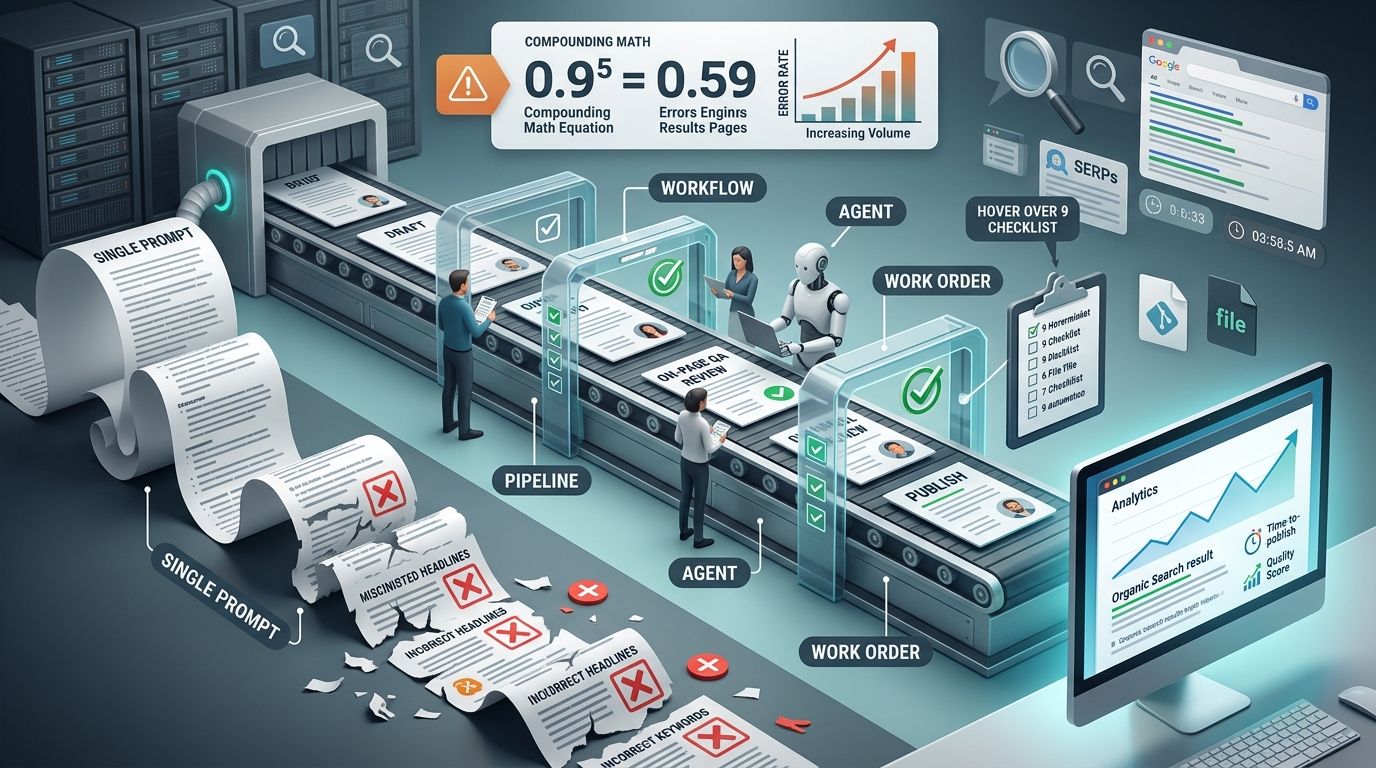
Then the math turns against you. Chain several of these steps together and reliability multiplies rather than averages. If each step in a five-step chain is 90% reliable, the end-to-end reliability is not 90%. It is 0.9^5, which works out to roughly 59%. That is a 41% chance that the final artifact carries a substantive error, even when every individual step is doing a respectable job. Push the chain to ten steps at the same per-step quality and end-to-end reliability collapses toward 35%. This is series reliability, the same logic that governs any system where every stage has to succeed for the whole to succeed. Treat those numbers as a model of how error compounds, with no claim to being a measured benchmark; the point is the shape of the curve rather than the exact figure.
Translated into a content operation, that compounding is why nearly one in three published pieces can ship with an error the moment steps stop being checked between stages. The error does not announce itself. A factual mistake in research quietly becomes a confident claim in the brief, which becomes a headline in the draft, which becomes a live page. The artifact's error rate tracks the compounded failure probability of the pipeline as a whole over the accuracy of any one model call.
The claim to hold onto before you read the rest of this: reliability comes from breaking work into discrete tasks, putting deterministic checks between them, and placing human judgment at the points that actually need it. It does not come from a longer, cleverer prompt. A longer prompt is still one step, still opaque, still unvalidated, and it fails in exactly the same ways once volume exposes it.
Step 1: Fix the Vocabulary So Your Team Means the Same Thing
Before you automate anything, get everyone using the same words, because most arguments about "should this be an agent" are really arguments about undefined terms. Here are the working definitions we use for SEO operations. A prompt is a single instruction to a model that returns one output. A prompt chain is a sequence where each output feeds directly into the next instruction, with nothing in between. A workflow is a set of predefined, code-orchestrated steps that always run in the same order. A pipeline is a set of repeatable stages, each with defined inputs, outputs, and checks, connecting one unit of work to the next. An agent is a component that decides which tools to call and what to do next based on the context it is given (Microsoft Learn). And an agent pipeline is a set of agents completing defined work orders and passing them through QA gates.
Mapping each concept to a concrete SEO task makes the limitation of each one obvious:
| Concept | SEO example | Documented limitation |
|---|---|---|
| Prompt | Generate one title tag | No validation, no trace, breaks at volume |
| Prompt chain | Keyword → brief → draft, one output feeding the next | Errors from step one silently compound downstream |
| Workflow | Brief generation from a fixed template | Cannot adapt when an input is missing or thin |
| Pipeline | Full SERP-to-QA execution with checks between stages | Requires designed inputs, outputs, and gates to hold reliability |
| Agent | Decide which SERP tool to query for a sparse keyword | Non-deterministic; needs guardrails and review |
| Agent pipeline | Agents completing SEO work orders through QA gates | Reliability depends on gates and context scoping, not model quality |
The genuine confusion is between pipeline and workflow, and the cross-task handoff distinction resolves it. A workflow is what a single person or agent does on one task, start to finish. A pipeline is the connective layer that moves the finished output of one task into the next task's inputs. Brief generation is a workflow. Moving an approved brief into a drafting agent and then into a QA gate is a pipeline. You need both, but confusing them leads teams to build a monolith when they needed seams.
Run a terminology honesty check on anything a vendor calls an agent. If the tool always executes the same fixed sequence regardless of input, it is a workflow wearing an agent's label, and there is nothing wrong with that, as long as you call it correctly. Calling a fixed workflow an agent sets the wrong reliability expectations: you start trusting it to handle edge cases it was never built to reason about, and it fails silently on the first input that breaks the template.
Step 2: Map Your Current SEO Production Sequence Before Automating Anything
You cannot automate a process you have not written down (Prefect). Start by listing the full production sequence in the order it actually executes:
- Keyword research
- Intent analysis
- Brief creation
- Team assignment
- Drafting
- On-page optimization
- Internal linking
- Technical checks
- QA gates
- Publishing handoff
- Performance monitoring
- Iteration
For each stage, record two things: how long it currently takes and who owns it. This is your baseline, and you will measure every automation decision against it. A representative baseline in a mid-volume operation looks like brief creation running 2 to 3 hours per asset, a review cycle taking 3 to 5 days, and total time-to-publish sitting at 2 or more weeks per piece. Write down your own real numbers, not aspirational ones, because Step 9 depends on them.
Next, mark every point where work already changes hands, where research hands off to briefing, briefing hands off to a writer, and a writer hands off to QA. These existing handoffs are your pipeline seams. You are not inventing new boundaries; you are formalizing the ones your team already lives with, which is why they are the safest places to insert a deterministic check later.
Finally, tag each stage as one-off or repeated more than 100 times a month. Volume decides what is worth systematizing. Producing an original founder interview once a quarter does not justify a pipeline. Generating keyword clusters and briefs for 100-plus target pages a month does, because that is where the compounding math is punishing you every single day.
Step 3: Score Each Stage for Automation Readiness
Not every stage should be automated, and intuition is a poor sorting mechanism. Score each stage against six signals by weighting error tolerance 3× and weighting task volume, task structure, time cost per task, context dependency, and task complexity 2× each.×). Each signal scores 0 to 3 before weighting, giving a maximum of 36.
Score error tolerance first, because it dominates the outcome. A stage falls into one of three buckets: minor errors are acceptable and self-correcting, errors require mandatory human review before anything ships, or the stage is unsuitable for automation entirely because a mistake carries real consequences. Anything touching Your-Money-or-Your-Life topics or legal claims lands in that last bucket regardless of how well it scores elsewhere (Google).
Once every stage has a total, sort into four action tiers. A stage scoring 28 to 36 can be automated with guardrails. A stage in the 20 to 27 range can be automated, but with mandatory human review before publish. A stage from 12 to 19 warrants draft-level assistance only, with the human still owning the output. And anything under 12 stays human.
Run your stages through this and the triage sorts itself out. SERP scraping and keyword clustering score high because they have high volume and tight structure, their errors carry low consequences, and those errors surface immediately as obviously wrong data. Original expert commentary and money-keyword strategy score low because volume is low, context dependency is high, and errors can cost you rankings or credibility.
The warning to internalize while you score: most automation failures come from poor scoping and from low-volume, high-variance tasks, not from a weak model. If you find yourself scoping a stage that runs a handful of times a month and looks different every time, the model quality is irrelevant. You are automating the wrong thing, and no upgrade fixes that.
Step 4: Write Each Automatable Stage as a Work Order
Every stage that passed the scoring gets rewritten as a work order, and a complete work order defines nine parts:
- Objective, in one sentence.
- Inputs, listed explicitly with their expected format.
- Tools and data sources the stage is allowed to touch.
- Instructions for how to do the work.
- Acceptance criteria that define a passing output.
- Deterministic QA checks that pass or fail without a human judging.
- Output format, specified exactly.
- Owner, the human accountable for this stage.
- Escalation rule, defining what happens when a check fails.
Acceptance criteria and output format have to be machine-checkable, not descriptive (NIST). "Return a high-quality keyword list" is descriptive and untestable. "Return a JSON array where every object has keyword, funnel_stage, and business_value, and funnel_stage is one of three allowed values" is checkable, and a check either passes or it does not. The difference between those two lines is the difference between a gate that catches errors and a gate that is decorative.
Borrow the constraint-and-permission pattern from production automation. For each work order, name the agent, the exact prompt it runs, the scopes it is allowed to access, the trigger that starts it, and the human assigned as its reviewer. Scoping permissions this tightly is what stops a drafting agent from wandering back into research and rewriting the brief it was supposed to follow.
Store work orders and QA criteria like code, under version control. When a published page turns out wrong, you need to trace exactly which version of the work order and which acceptance criteria produced it. Without versioning you are debugging a moving target, and every fix risks silently changing three other stages.
Step 5: Build Concrete Work Orders for the Core SEO Stages
SERP and Keyword Research Work Order
The inputs are seed topics and the target market. The tools are a SERP data source and Search Console for existing performance signals. The acceptance criteria require every keyword to be categorized by business value and funnel stage, because an uncategorized keyword list forces the next stage to redo the thinking. The output format is a structured list with those fields present on every row. The escalation rule fires when the data comes back thin: if fewer than a defined threshold of keywords return, or if Search Console has no history for the topic, the stage pauses and routes to a human rather than inventing coverage.
Content Brief Work Order
The brief is where most downstream quality is won or lost, so require a full set of inputs before the work order can start:
- Primary and secondary keywords
- Confirmed search intent
- Target word count derived from competitor analysis, not guessed
- Top-ranking URLs for the query
- Content gaps the current SERP leaves open
- Required internal links
- Semantic entities to cover
- URL slug
- Title tag structure
Acceptance criteria check that every one of those fields is populated and internally consistent. But roughly half of brief creation stays human, and deliberately so. The machine assembles the structured inputs; the human supplies the angle, the insight the SERP does not already contain, and the final call on whether this brief is worth a writer's time.
Draft Generation Work Order
The only input is the approved brief. The constraint that makes this reliable is that the drafting agent sees the brief and nothing upstream. It does not see the raw research, the SERP scrape, or the keyword list, because handing it all of that invites it to re-litigate decisions the brief already settled and to pad the draft with unsupported examples. Acceptance criteria tie directly to brief coverage: every required entity must be present, every required internal link must be placed, and the word count must fall within range.
E-E-A-T handling becomes explicit checks rather than a vague hope:
- Author bio sourced and attached to a real, qualified person (theStacc).
- External citations present for every factual claim that needs one.
- Internal subject-matter-expert verification logged for the claims that need it.
- An extra review layer triggered automatically for any YMYL content.
On-Page and Technical QA Work Order
Encode the pre-publish checks so they run the same way every time:
- Heading structure
- Required entities present
- Internal links placed and resolving
- Metadata complete
- Schema valid
- Canonical tags correct
- Alt text on every image
- URL structure conforms
- Page renders
- Mobile responsive
Every one of these is a deterministic pass or fail. Schema either validates or it does not. A canonical tag is either present and correct or it is not. Keep subjective judgment out of this work order entirely, because the moment a check requires an opinion, it stops being a gate and becomes another review meeting.
Editorial Review Work Order
This is the human work order, and it defines what routes to a person: tone, brand alignment, factual accuracy on the exceptions the automated checks cannot resolve, and the final publication-readiness decision. It also defines the escalation path for failed automated checks, so that when the technical QA work order flags a broken schema or a drafting agent misses required coverage, there is a named human who receives it and a defined next action rather than a silent failure sitting in a queue.
Step 6: Connect the Work Orders Into a Pipeline With QA Gates
Now assemble the work orders into a sequence where each output has to clear a deterministic check before the next stage is allowed to start. The check between research and briefing verifies the keyword list is structured and categorized. The check between briefing and drafting verifies every required brief field is present. This is the connective layer that keeps the compounding math from working against you, because a caught error at stage two never propagates to stage five.
Place four approval gates in order:
- Editorial review
- SEO review
- Legal and compliance review
- Technical review
Apply strict context control at every gate: each agent sees only the upstream outputs its role actually needs. In our reference build, scoping context this tightly did three concrete things. It stopped agents from repeating research already done upstream, it eliminated unsupported examples that appeared when an agent had access to raw material it was told to summarize, and it stopped editors from undoing corrections a previous stage had already applied, because the later stage never saw the pre-correction version to "restore."
Add failure handling to every gate, and classify failures before reacting to them. Retriable failures are transient: rate limits, provider throttling, network timeouts (Koder.ai). Handle these by retrying the stage. Non-retriable failures are permanent: bad requests, invalid schemas, auth errors, or genuine data-quality problems from an upstream agent. Do not retry these; short-circuit the stage and escalate to the assigned human. For the decision points that need judgment, add a human-in-the-loop interrupt that writes a checkpoint of completed stages and their outputs, pauses, and then resumes from that saved state once the human approves, edits, or overrides. The reviewer becomes a special stage that can change the canonical context without forcing you to re-run every expensive upstream stage.
For stages that adapt, such as a brief that needs a second research pass when the SERP is unusually competitive, design an iterative control loop rather than a single straight line. The stage can send work back one step, re-run under revised inputs, and continue, instead of failing the whole pipeline because the first pass was insufficient.
Step 7: Start Single-Agent, Add Agents Only When Forced To
Begin with the simplest design that works, which usually means one agent handling as much of the scope as it can hold. Add a second agent only when a single one can no longer keep the tool set or the task scope coherent, not because a multi-agent architecture looks more sophisticated on a diagram.
Our own build made the point directly:
Internal case study: consolidating a nine-agent pipeline
[Screenshot placeholder: before/after agent topology diagram]
- Before: Nine agents running in series, from a Researcher through to a Feedback Critic, each handing off to the next.
- Result (before): A full article produced in 20 to 45 minutes. It worked, but reliability varied run to run and context leaked between handoffs.
- After: Overlapping roles consolidated into fewer agents.
- Result (after): Reliability went up and runtime came down.
- Takeaway: The extra agents were not adding quality; they were adding handoffs, and every handoff is another place for context to leak or contradict.
Two forces explain why more agents did not help. First, splitting a coherent task across agents introduces coordination overhead that the model would have handled internally for free. Second, when inference is slow, each added agent multiplies total runtime, because the stages run in series and every one waits on the last. Nine sequential inference calls take roughly nine times as long as one, and you paid that cost for reliability that got worse (Zhuowan Li).
Multi-agent orchestration is genuinely warranted when the task truly spans distinct tool domains or sub-teams that one agent cannot hold at once. When you reach that point, choose deliberately among four coordination patterns. In a supervisor pattern, one manager agent routes tasks to specialists and aggregates results. A hierarchical pattern uses a manager-to-worker tree where upper levels plan and lower levels execute. A sequential pattern runs agents in a fixed order, each consuming the previous output. And a swarm pattern has many autonomous agents work in parallel with minimal central control. As general guidance, most working systems combine these, typically a supervisor routing into a sequential pipeline. Start with the one that matches your actual task shape, not the most impressive one.
Step 8: Instrument the Pipeline So You Can See Where It Breaks
Track a fixed set of metrics from the first day the pipeline runs, because you cannot improve what you are not measuring, and the compounding failures hide until you look for them: (Tian Pan)
- Time-to-publish, end to end
- Quality scores per stage
- Approval cycle time per gate
- Resource utilization
- Downstream rankings, organic traffic, and conversions on published pages
A simple dashboard makes the bottleneck obvious rather than felt:
[Screenshot placeholder: pipeline monitoring dashboard]
| Stage | Owner | Avg cycle time | Failure rate | Bottleneck? |
|---|---|---|---|---|
| Keyword research | Automated + reviewer | 15 min | Low | No |
| Brief creation | SEO lead | ~30 min | Low | No |
| Draft generation | Drafting agent | 20–45 min | Medium | No |
| SME verification | Subject-matter expert | 4 days | Medium | 80% of total delay |
| Legal review | Compliance | 4 days over average | Low | Yes |
| Technical QA | Automated | 5 min | Low | No |
Real signals point to real bottlenecks. When legal review is running four days over its average, or when 80% of your total delay is sitting inside SME verification, that is a concrete pipeline complaint; it is a specific stage with a name and an owner you can go fix. Instrumentation turns a felt problem into a located one.
Set up memory and state so runs are repeatable. Keep short-term working state for the current run, and keep long-term records split by type: episodic (what happened on past runs), semantic (facts and entities the pipeline has verified), and procedural (how a given work order was executed). Checkpoint at every gate so any run can resume from a saved point instead of restarting, which is what makes the human-in-the-loop interrupts from Step 6 cheap rather than costly.
Finally, connect live URLs back to their performance data. When a published page's traffic or rankings decline past a threshold, that signal should trigger a refresh work order automatically, feeding the declining page back into the front of the pipeline as new input. This is how the iteration stage from Step 2 stops being a quarterly manual chore and becomes a closed loop.
Step 9: Calculate Whether Each Automated Stage Actually Pays
The ROI rule is per stage, per stage: automate a stage when its monthly cost is below the human labor cost of doing that same repeatable task by hand. A stage that clears the automation-readiness scoring can still fail this test if it runs rarely, so you check both.
Include the full cost, not just the subscription line:
- Setup and integration
- Prompt and workflow design
- QA time to build and maintain the checks
- Human editing of outputs
- API usage
- CMS integration
- Team training
- Security review
- The cost of low-quality output that slips through
That last item is the one teams forget, and it is often the largest, because a bad page that ships has a cost that dwarfs the API bill that produced it.
Model your savings against verified reductions. Brief creation drops from 2 to 3 hours down to about 30 minutes once the structured inputs are automated and the human only supplies judgment. One landing-page workflow we measured went from 8 hours to 2 to 3 hours, a 62.5% to 75% reduction. Time-to-publish compresses from 2-plus weeks to 3 to 5 days once the gates run automatically instead of waiting on scheduled review meetings.
Tool cost reference points help you sanity-check the API line, with the caveat that these per-unit figures exclude human review, which is where most of the real cost lives:
- Content generation runs roughly $2.19 to $3.30 per article at the mid tiers of the market (for example, per-article costs around $2.99 to $3.23 on some optimization-plus-generation plans, and near $3.33 on high-volume agency tiers).
- On-page optimization tools charge per page, and the per-page cost falls as volume rises.
- Rank tracking and content-decay monitoring are priced per keyword or per page.
Choose your stack against volume and control needs. A no-code stack suits lower volume and teams that want to move fast without engineering time. A custom internal pipeline suits high volume and teams that need full control over context scoping and versioning. An off-the-shelf platform suits teams that want the pipeline structure and monitoring handled without building the connective layer themselves; full research-to-publish platforms with per-article E-E-A-T scoring built into the flow are one example of that category.
| Stage | Baseline (manual) | With pipeline | Reduction |
|---|---|---|---|
| Brief creation | 2 to 3 hours | ~30 minutes | Up to ~75% |
| Landing-page workflow | 8 hours | 2 to 3 hours | 62.5% to 75% |
| Time-to-publish | 2+ weeks | 3 to 5 days | Multiple-fold |
Step 10: Know Which Stages to Leave Out of the Pipeline
Some stages stay human, and knowing which ones protects the whole system. Keep high-judgment SEO strategy, keyword selection at the money-keyword level, and original expert writing and thought leadership out of the pipeline entirely (LSEO). These scored low in Step 3 for the same reason: low volume, high context dependency, and errors that cost you real credibility.
Certain content types require expert review before publish no matter how the pipeline is performing: legal, medical, financial, and other YMYL claims. The automated checks can flag them and route them, but a qualified human signs off, and that sign-off is not optional.
Pipelines are the wrong move in three situations. Low-volume content programs never earn back the setup cost. Poorly defined processes cannot be automated at all, because you would be encoding chaos. And a team without the QA capacity to actually staff the review gates should not build gates, because an unstaffed gate is worse than no gate, since it creates the appearance of a check that never runs.
The reality check to carry out of this: the deployments that work are human-augmenting rather than fully autonomous. Agents earn their keep across the first 80% of the work, the repeatable, structured, high-volume stages, and they become unreliable exactly at the last 20% where judgment, nuance, and accountability live. Build for the 80%, and staff the 20%.
Common Mistakes That Break SEO Agent Pipelines
Trying to fully automate before the manual process is documented and stable is the most common failure, because you cannot systematize a sequence you cannot describe, and the pipeline will simply automate the inconsistency.
Skipping the deterministic checks between stages and leaning on prompt quality to hold everything together brings back the compounding math from the opening, where a five-step chain of 90%-reliable steps lands at 59% end to end (NIST ITL). The checks exist precisely to break that chain into short verified segments.
Letting every agent see all upstream context produces duplicate research and contradictory edits, because an agent handed raw material it was told to summarize will re-summarize it, and a later stage that sees the pre-correction version will "restore" it.
Propagating the widely copied definition error that says agents are best for predictable, repeatable tasks sets exactly the wrong expectation, because predictable and repeatable tasks are usually best served by a deterministic workflow, and agents earn their keep on the tasks that need contextual decisions.
Publishing without staffing the human review gates that the tier scores marked as mandatory quietly reintroduces every risk the pipeline was built to remove, and it does so invisibly, which is the most dangerous kind of failure.
What to Build First This Week
Pick your single highest-volume, highest-error-tolerance stage, which for most teams is SERP research or brief creation, and write one complete work order for it using the nine-part anatomy from Step 4. Do not build the whole pipeline. Build one work order, fully, with machine-checkable acceptance criteria and a named owner.
Then run it manually with a strong model once, reading the output yourself against the acceptance criteria, before you automate anything. Once it holds up by hand, run it as a constrained pilot on real data, still outside the pipeline, so you can watch it fail on inputs you did not anticipate while the blast radius is small.
Watch one number during the pilot: end-to-end reliability across the chain. That is the number the compounding math punishes, and it is the exact thing your deterministic gates exist to protect. If a single well-scoped work order holds its reliability on real data, you have proof the approach works, and you have earned the right to wire the next stage in behind it.