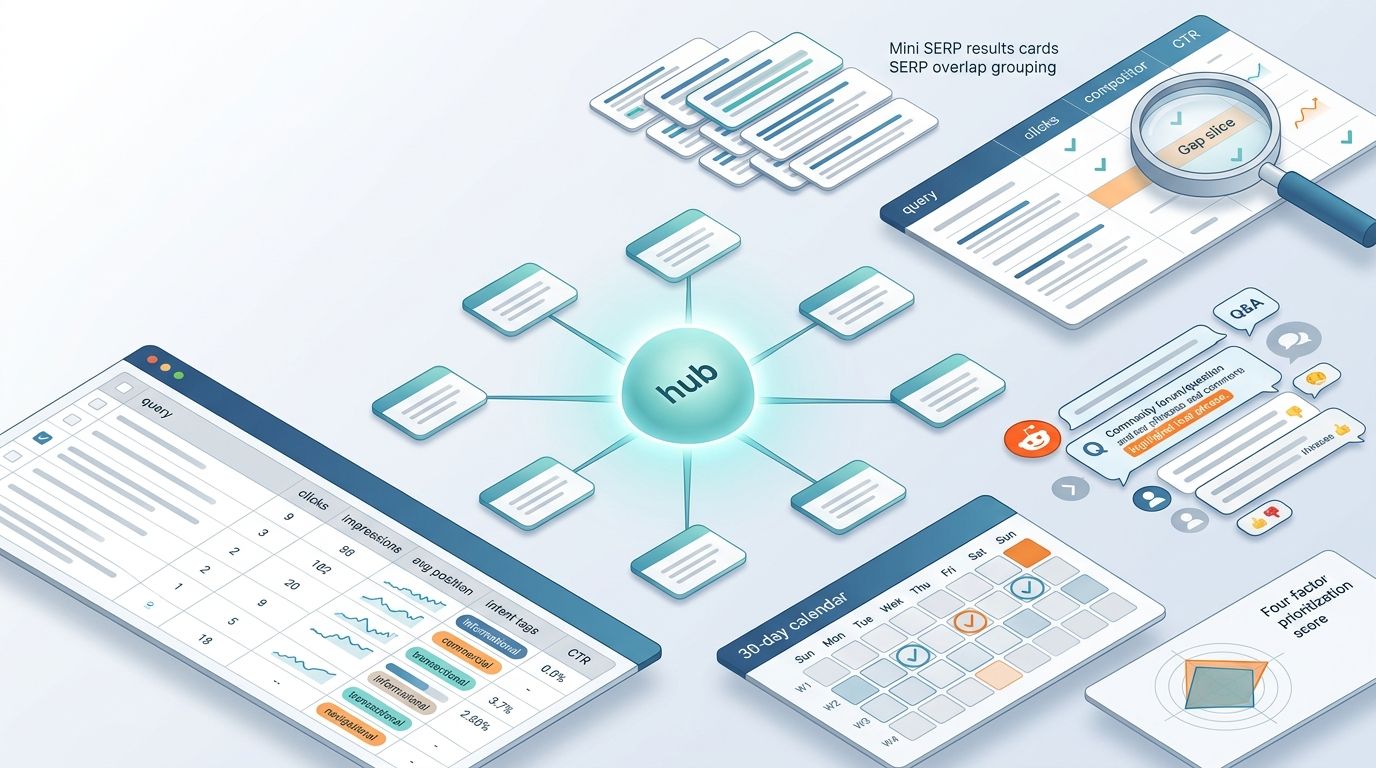

Why This Method Exists: The Aggregated Demand Problem Most Teams Miss
Most content teams spend weeks brainstorming topic ideas, then validate them by plugging individual keywords into Ahrefs or SEMrush. They see "90 searches/month," label it low-value, and move on. That single rejected keyword represents one phrasing of a question asked dozens of different ways. Add up all variants, and you're looking at 1,000+ monthly searches that nobody on your team ever saw.
The cost of this blind spot is real. You ship content based on gut feel. Half of it earns zero organic traffic because there was never validated demand. The other half targets head terms where you can't compete. Meanwhile, competitors who aggregate community questions into clusters are quietly ranking pages you never built.
Take "does oat milk cause acne." Individually, it shows ~90 monthly searches. But search that query and you'll find Reddit ranking at position #2, the same question repeated 5+ times across SERP results in slightly different phrasings, and no authoritative resource answering it comprehensively. The true topic demand, once you cluster all phrasing variants, blows past the number any single keyword report would show.
This workflow produces something specific: a scored, intent-ranked content backlog with recommended page types for each entry. Every item in the final output has a documented reason for its position, sourced from Reddit frequency data, GSC impression data, and SERP feature analysis. This is not a brainstormed idea list or a spreadsheet of loosely gathered Reddit threads.
One clarification before we start. Triangulation here means a 3-source content validation workflow: Reddit community signal, Google Search Console demand data, and SERP feature/competitor analysis. Three independent data sources confirming (or denying) the same opportunity.
Step 1: Extract 10 to 20 High-Signal Questions from a Target Subreddit
You need raw material. The goal here is to pull candidate questions from Reddit that have enough community repetition and search-query potential to survive validation in Steps 2 through 5. Two paths to get there.
Method A: SEO-Tool-Driven Extraction (Ahrefs Site Explorer)
Plug the full subreddit URL into Ahrefs Site Explorer. Pull the Organic Keywords report.
From a single active subreddit, you'll start with 200,000+ keywords. That raw dataset is unusable without filtering.
Filter sequence:
- Remove Reddit-specific queries (anything containing reddit, subreddit, or r/)
- Remove review intents (these skew toward product-specific, low-clustering potential)
- Apply a max keyword difficulty threshold appropriate to your niche and domain authority
- Apply a max search volume threshold to exclude head terms you can't realistically rank for
Post-filtering, expect roughly 22,000 keywords from a 200K starting point. That's an 89% reduction, and the remaining set is still too large to work with manually. Step 2 handles compression.
One thing to be honest about: every competitor with an Ahrefs subscription can pull this same list. The extraction step alone creates zero advantage. The entire value of this method lives in what happens from Step 2 onward.
[Screenshot placeholder: Ahrefs Site Explorer → Organic Keywords report for a subreddit, with filters applied showing the reduction from 200K+ to ~22K keywords]
Method B: API Scraping + AI Cleaning (Free, Tool-Light)
If you don't have an Ahrefs subscription, this path works.
Tool chain: Reddit API → Google Colab Python script → CSV output. Optionally, pipe the output through OpenAI's API to normalize slang, abbreviations, and colloquialisms into clean query-style phrasing.
Input: a single-column CSV of subreddit names. These are case-sensitive, so SkincareAddiction is not the same as skincareaddiction.
Automated alternative: redditinsights.ai replicates the Colab workflow for free, no code required. Upload your subreddit list, get scraped questions back as a CSV.
Raw uncleaned questions (with slang, typos, Reddit-specific shorthand) are still viable for clustering in the next step. Cleaning helps, but isn't blocking.
Selection Criteria for High-Signal Questions
Not every scraped question is worth carrying forward. Three filters determine high-signal status:
- Repetition: The question appears multiple times across threads or across multiple subreddits. A question asked once might be an edge case. Set a repetition threshold appropriate to subreddit size (for a subreddit with 500K+ members, we look for questions appearing at least 3 to 5 times within a recent window; smaller subreddits may warrant a lower threshold).
- Answer quality gap: Responses are contradictory, incomplete, or cite no sources. This is your content gap indicator. If Reddit's own community can't resolve the question, there's room for a definitive resource.
- Query portability: The question is generic enough to translate into a search query pattern. "What's the best moisturizer for tretinoin peeling?" translates directly. "Why did my HG get discontinued at TJ's?" does not. It's locked to subreddit-specific slang and context that won't survive as a Google search.
Carry 10 to 20 questions forward. Fewer than 10 gives you too little to cluster. More than 20 creates noise that slows down validation without improving output quality.
Step 2: Cluster Questions into SEO-Ready Topic Groups
Thousands of individual Reddit questions need to collapse into fewer topic groups, each with a realistic total demand estimate. Without this step, you'll end up targeting individual low-volume queries (60-70 monthly searches each), producing content that looks justified by community signal but generates no measurable traffic.
Here's the math that makes clustering non-optional. Start with ~22,000 filtered keywords from Step 1. After clustering, those compress into ~3,890 clusters. That's an 82.3% reduction in line items you need to evaluate.
The volume amplification effect: An individual keyword showing 60 to 70 monthly searches looks not worth targeting in isolation. But the cluster containing that keyword, with all its phrasing variants, might total ~7,000 monthly searches. The head term within that cluster could sit at ~2,800 SV. Same topic, radically different business case. The cluster justifies a dedicated content asset. The individual keyword never would have.
Technical Constraint: Adding Search Volume for Clustering Tools
Keyword Insights (and similar clustering tools) requires a search volume column in your upload file. If you scraped questions from Reddit via Method B, you won't have volume data attached.
Workaround 1: Add an arbitrary volume value (e.g., 10) to every row in your CSV. This lets the tool cluster by semantic similarity, but sacrifices accurate demand sizing. You'll get meaningful groups without knowing their true combined volume.
Workaround 2: Re-run your cleaned questions through a keyword tool (Ahrefs, SEMrush, or even Google Keyword Planner) to pull actual search volumes before uploading. More accurate, but adds a step and potentially a tool cost.
Operational note: If you're uploading multiple CSVs from different subreddits, deduplicate before upload. Clustering tools won't flag exact matches across separate uploads, and duplicate entries inflate your cluster counts and distort volume estimates.
Step 3: Validate Demand and Domain Fit in Google Search Console
Reddit tells you what people care about. Clustering tells you the aggregate volume. GSC tells you whether your specific domain already has any traction for these topics and where the gaps sit.
Query-Led Validation
Open GSC → Performance → Search Results → Queries tab.
[Screenshot placeholder: GSC Performance report, Queries tab, sorted by Impressions descending, with CTR column visible]
Sort by Impressions (descending). You're looking for two patterns:
- High impressions, low clicks/low CTR: Your pages appear in results for these queries, but users aren't clicking. Either your snippet doesn't match the intent, your title/description is weak, or you're ranking too low on the page. Direct opportunity: improve existing content or create a better-matched page.
- Emerging query trends: Queries that recently started generating impressions where you previously had none. These are content gaps before competition reacts.
Cross-reference this list against your Reddit-sourced clusters from Step 2. If your domain already gets impressions for queries related to a cluster, that cluster has higher validation confidence. You're not starting from zero.
Page-Led Validation
Switch to the Pages report. Find URLs with the most clicks and impressions. For each high-performing page, click through to see which queries drive those impressions.
Three possible outcomes per page:
- Expand: The page ranks for queries it only partially answers. Add content sections addressing those queries.
- Refresh: The page has declining impressions over time. Update stale data, examples, or recommendations.
- Create new: The queries driving impressions don't match any existing page well. Build a net-new content asset targeting that cluster.
Segmentation and Time Windows
Check the top Countries and Device breakdowns. Mobile vs. desktop matters for content format decisions (we'll get to this in Step 4, where mobile SERPs show dramatically different feature distributions).
Time windows to review:
| Window | What It Shows |
|---|---|
| Past 28 days | Current snapshot, useful for catching sudden changes |
| 3 months | Short-term trend, filters out weekly noise |
| 6 months | Seasonal patterns become visible |
| 1 year | Long-cycle trends + year-over-year comparison |
| Compare vs. previous period | Directional shifts (gaining or losing ground) |
A full review across these windows takes roughly 30 minutes. We recommend doing it at least monthly.
Weekly monitoring (Mondays): Check your top 50 queries that moved up or down significantly, and flag any pages losing impressions.
Indexation Health Gate
Before you leave GSC, check the Crawled, currently not indexed bucket under Pages → Indexing.
If new content isn't getting indexed, everything upstream is wasted. You validated demand, built the content, published it, and Google decided not to include it. Review your Sitemaps report to confirm Google crawled recently. If pages are stuck in the crawled but not indexed state, investigate thin content issues, duplicate content, or crawl budget constraints before publishing anything new from your backlog.
[Screenshot placeholder: GSC Indexing report showing the "Crawled, currently not indexed" bucket with example page count]
2024 GSC data caveat: Google deprecated the num=100 SERP parameter, which may cause apparent impression drops and shifts in average position interpretation. If you see a sudden, across-the-board drop in impressions without corresponding traffic changes, this reporting change (not an actual ranking drop) may be the cause.
Step 4: Audit SERP Features and Determine Required Page Type
Knowing that demand exists isn't enough. You need to know what the SERP looks like for each priority cluster, because the SERP dictates the page format required to compete.
What to Check for Each Priority Cluster
Open the target query in an incognito browser, or use a SERP feature tracking tool (SEMrush Position Tracking, Ahrefs Rank Tracker).
Record which SERP features appear. Reference benchmarks for approximate prevalence:
| SERP Feature | Approximate Prevalence |
|---|---|
| Reviews/Ratings | ~50% of product/service SERPs |
| Local Pack | ~19% |
| Featured Snippet | ~10% |
| Video Results | ~5% |
| Instant Answers | ~5% |
| Shopping Ads | ~2% |
| People Also Ask | Present in a high percentage of SERPs |
| Top Stories | Appears for news-adjacent and trending queries |
Assess Zero-Click Risk
If Instant Answers or Knowledge Graph panels dominate the SERP, the query may be low-ROI despite high volume. Users get their answer without clicking anything. Check whether the answer Google surfaces is complete or partial. Partial answers leave room for a click-through.
If Featured Snippets appear, you have an actionable target. Structure your content with:
- Direct-answer paragraphs of 40 to 60 words
- HTML lists (ordered or unordered)
- Tables with clear headers
Featured Snippets are also used in voice search responses, which adds an engagement channel beyond clicks.
Mobile vs. Desktop Format Divergence
This is where most teams under-invest. Mobile and desktop SERPs are not the same page with a smaller screen.
- Mobile SERPs show 12.5x more images and 3x more videos than desktop
- Desktop SERPs show 2x more ads and Featured Snippets
Cross-reference this with the GSC device segmentation from Step 3. If 80% of impressions for a cluster come from mobile, and mobile SERPs heavily favor video, your comprehensive guide format might need an embedded video or visual walkthrough to compete. A text-only article would be structurally disadvantaged on the primary device.
Competitor Page Analysis
For each priority cluster, identify what page types currently rank in positions 1 through 5. Record the format: guide, comparison, template, tool, listicle, forum thread, or something else.
The specific signal to watch for: if Reddit threads rank in the top 5 and non-forum results are thin, this is a direct SERP weakness signal. Google is showing forum content because nothing better exists. A well-structured page targeting that cluster can displace those forum results.
People Also Ask as Subtopic Signal
Each PAA question is a subtopic signal from Google itself. Answering PAA questions well on your page increases the probability of capturing that PAA slot.
Use PAA questions to define H2/H3 subheadings and FAQ sections on the target page. This is free structural guidance from Google about what subtopics they associate with the query.
Step 5: Classify Intent and Score Each Cluster Using the 5-Factor Rubric
Now you have clusters with demand data, SERP feature maps, and competitor analysis. The next step: classify intent and score each cluster so the backlog sorts itself into a defensible priority order.
Intent Classification (4+2 Bucket Model)
| Intent Type | Definition | Funnel Stage |
|---|---|---|
| Informational | User seeks knowledge or answers | TOFU |
| Commercial Investigation | User comparing options, evaluating solutions | MOFU |
| Transactional | User ready to buy or act | BOFU |
| Navigational | User seeking a specific site or page | Skip unless brand-relevant |
| Local | SERP shifts to map pack/local directories | Requires local content strategy |
| Branded | Brand terms that may be commercial or transactional | Not purely navigational; assess case by case |
Most Reddit-sourced clusters fall into Informational or Commercial Investigation. Transactional clusters are rarer from community sources but extremely valuable when they appear.
Apply the Business Potential Filter
Before scoring, run each cluster through a business potential check. Score how naturally your product or service can be positioned as the answer to the cluster's core question.
- High BP: The query naturally allows product mention as the answer. Example: "how to automate keyword research" maps directly to a tool with auto keyword research capabilities.
- Low BP: Product mention would feel forced or irrelevant. Example: "what does retinol do to your skin" for a SaaS company.
This filter prevents investing in high-volume clusters that will never convert. A 7,000 SV cluster with zero business relevance is worth less than a 700 SV cluster where your product is the natural answer.
The 5-Factor Scoring Rubric
Score each cluster on five factors using a 1-5 scale. Below are the factors, their data sources, and explicit scoring anchors so every team member scores consistently.
| Factor | What It Measures | Data Source |
|---|---|---|
| Reddit Frequency | How many times the question appears across threads/subreddits | Reddit scrape or manual audit |
| SERP Weakness | Does Reddit rank top 5? Are results thin or forum-dominated? How many SERP features compete? | Step 4 audit |
| GSC Impressions | Does your domain already get impressions for related queries? | Step 3 validation |
| Cluster Volume | Aggregated search volume across all query variants in the cluster | Step 2 clustering output |
| Business Potential / Intent Fit | Can your product be naturally positioned as the answer? What intent type? | Intent classification + business judgment |
Scoring Anchors (1 / 3 / 5 Definitions)
Factor 1, Reddit Frequency:
- 1: Question appears once or twice across all scraped threads
- 3: Question appears in 3 to 5 separate threads or across 2 subreddits
- 5: Question appears in 6+ threads or across 3+ subreddits
Factor 2, SERP Weakness:
- 1: Positions 1-5 held by strong, well-structured pages from high-authority domains; no Reddit or forum results in top 10
- 3: Mixed results; 1-2 forum threads in top 10, some thin or outdated content in top 5
- 5: Reddit or forum threads hold 2+ of positions 1-5; remaining results are thin, outdated, or format-mismatched
Factor 3, GSC Impressions:
- 1: Zero impressions for any query in the cluster over the past 3 months
- 3: 100-500 impressions across related queries, or impressions present but CTR below 1%
- 5: 500+ impressions with identifiable click-through, indicating your domain already has relevance signals
Factor 4, Cluster Volume:
- 1: Aggregated cluster volume under 500 monthly searches
- 3: Aggregated cluster volume between 500 and 3,000 monthly searches
- 5: Aggregated cluster volume above 3,000 monthly searches
Factor 5, Business Potential / Intent Fit:
- 1: Product cannot be mentioned without feeling forced; query is tangential to your offering
- 3: Product can be mentioned in a supporting role (e.g., one section of a broader guide)
- 5: Product is the natural, direct answer to the query; high conversion probability
Numbered Scoring Workflow
- Pull up the cluster spreadsheet from Step 2 with all clusters listed as rows.
- For each cluster, open the Reddit scrape data and count distinct threads containing the question. Assign the Reddit Frequency score (1/3/5) using the anchors above.
- Open your Step 4 SERP audit notes for the cluster's representative query. Assess the strength and format of positions 1-5. Assign the SERP Weakness score.
- Check GSC (Step 3 data) for impressions on any query within the cluster. Assign the GSC Impressions score.
- Record the aggregated cluster volume from Step 2 output. Assign the Cluster Volume score.
- Evaluate business potential by asking: if we ranked #1 for this cluster, could we naturally mention our product as the answer? Assign the Business Potential score.
- Sum all five scores for the composite. Record in the Composite Score column.
- Sort descending by composite score. Flag ties by giving priority to the cluster with the higher Business Potential score.
Composite score: More repetitions, weaker SERP, existing impressions, higher aggregated volume, and stronger business fit each increase the total. The composite score determines position in the final backlog.
For our own content planning, we weight Business Potential and SERP Weakness slightly higher than raw volume because a winnable, convertible cluster at 2,000 SV outperforms an unwinnable, unconvertible cluster at 10,000 SV. Adjust weights based on your team's strategic priorities.
Step 6: Assign Page Types and Build the Ranked Content Backlog
Scores are set. Now each cluster gets a page type assignment, and the whole thing becomes a publishable backlog.
Page Type Mapping by Intent Score
| Intent Classification | Recommended Page Type |
|---|---|
| Transactional (high intent) | Comparison page or product landing page |
| Commercial investigation | Comparison guide, "best X for Y" post, decision framework |
| Informational (procedural) | Step-by-step guide, tutorial, checklist |
| Informational (conceptual) | Explainer, definitive guide, glossary-style post |
| Mixed intent | Hub page with linked sub-pages, or long-form guide with conversion CTAs at intent-matched sections |
Match these against what you learned in Step 4's competitor analysis. If the top 5 results for a commercial investigation cluster are all comparison guides, your comparison guide needs to be structurally better (clearer criteria, more options evaluated, fresher data), not a different format entirely.
Sample Backlog Row (Anonymized Internal Example)
We ran this workflow against a health and wellness subreddit for one of our projects. Here is one row from the resulting backlog:
| Column | Value |
|---|---|
| Cluster name | oat milk skin reactions |
| Representative query pattern | does oat milk cause acne |
| Intent classification | Informational |
| Reddit frequency score | 4 (appeared in 5 threads across 2 subreddits) |
| SERP weakness score | 5 (Reddit holds positions #2 and #4; remaining top-5 results are thin forum threads and one outdated blog post) |
| GSC impressions score | 2 (47 impressions over 3 months, 0 clicks) |
| Cluster volume | 1,800 (aggregated across 27 query variants) |
| Cluster volume score | 3 |
| Business potential score | 3 (product could be referenced in a recommendations section, but isn't the direct answer) |
| Composite score | 17 |
| Recommended page type | Definitive guide with FAQ section sourced from PAA |
| Validation notes | High SERP weakness, strong Reddit frequency. GSC shows early impressions confirming Google associates our domain with this topic area. PAA reveals 4 subtopics to structure as H2s. |
[Screenshot placeholder: Final backlog spreadsheet with 10+ rows sorted by composite score, showing all columns from the table above]
Mini Case Study: From Subreddit Scrape to Published Backlog
Context: We applied this workflow to a mid-size wellness brand's content strategy using r/SkincareAddiction as the primary subreddit.
Inputs:
- Method A extraction yielded 214,000 raw keywords
- Post-filtering: 21,800 keywords
- Step 2 clustering: 3,740 clusters (82.8% reduction)
- Step 3 GSC cross-reference: 312 clusters had existing impressions on the brand's domain
Scoring output:
- 38 clusters scored composite 15 or above (out of 25 max)
- Top 10 clusters all had SERP Weakness scores of 4 or 5 (Reddit in top 5 for each)
- 6 of the top 10 had GSC impressions scores of 3+, confirming the domain already had early relevance
Result: The brand's content team received a 38-item prioritized backlog with page type assignments and validation notes. The first 5 pieces were published within 6 weeks. Indexation was confirmed within 7 days for each using the monitoring protocol from Step 3.
Final Deliverable Format
Each row in the backlog contains:
| Column | Source |
|---|---|
| Cluster name | Step 2 clustering output |
| Representative query pattern | Highest-volume query in the cluster |
| Intent classification | Step 5 intent analysis |
| Reddit frequency score (1-5) | Step 1 extraction + manual audit |
| SERP weakness score (1-5) | Step 4 SERP audit |
| GSC impressions score (1-5) | Step 3 GSC validation |
| Cluster volume | Step 2 clustering output |
| Business potential score (1-5) | Step 5 business potential filter |
| Composite score | Sum of all factor scores |
| Recommended page type | Step 6 intent-to-format mapping |
| Validation notes | Why this item made the list |
Sort by composite score descending. Every item has a documented audit trail: here's the Reddit data that surfaced it, here's the GSC data that confirmed demand, here's the SERP analysis that proved it's winnable. A skeptical stakeholder can trace any row back to its sources.
Tool-Light vs. Tool-Heavy Implementation Paths
| Component | Tool-Light (Free) | Tool-Heavy (Paid) |
|---|---|---|
| Reddit extraction | Reddit native search + redditinsights.ai | Ahrefs Site Explorer |
| SERP analysis | Google incognito manual audit | SEMrush Position Tracking / Ahrefs Rank Tracker |
| Clustering | Manual grouping or free tools | Keyword Insights |
| Intent classification | Manual analysis | Ahrefs MCP with Claude for scaling |
| Demand validation | GSC (free) | GSC (free) |
Our recommendation: start tool-light to validate the workflow produces usable output for your niche. Add paid tools only after you've confirmed the process works. We've seen teams buy Keyword Insights subscriptions, run the workflow once, realize their subreddit source was wrong, and waste the entire investment. Confirm your inputs produce real clusters before adding tool spend.
Where Most Teams Break This Process: The Three Failure Points to Monitor
Three specific failure modes kill this workflow. We've watched each one happen across client engagements and internal projects.
Failure point 1: Skipping clustering. Teams take individual Reddit questions, see the community engagement, and write content targeting single low-volume keywords. The article gets published, the team reports "we addressed a real community need," and the page generates negligible organic traffic because there was never enough aggregated search demand to justify a standalone asset. The fix is non-negotiable: never target an individual Reddit question without first checking whether it belongs to a larger cluster with meaningful combined volume. If the cluster total doesn't justify a dedicated page, either fold the question into an existing piece of content or drop it.
Failure point 2: Ignoring indexation. GSC confirms demand. The content gets written, optimized, published. Then the page sits in Crawled, currently not indexed for weeks. The entire upstream process (every hour of extraction, clustering, validation, and scoring) produces nothing. Check indexation status within 7 days of publishing any piece from the backlog. If the page isn't indexed within that window, investigate immediately. Common causes: thin content relative to competing pages, duplicate content issues, or crawl budget exhaustion on large sites. Don't wait for the monthly GSC review to catch this.
Failure point 3: Scoring once and forgetting. Google's interpretation of a query changes over time. SERP features shift. New competitors enter. A cluster you scored as high-opportunity six months ago may now be dominated by a competitor who published a comprehensive guide after you did your analysis. Re-score the backlog quarterly using the same rubric. Compare against the previous scoring period to catch directional changes before they become traffic losses. If a cluster's SERP weakness score dropped from 4 to 2 because a strong competitor entered, reprioritize. If a cluster's GSC impressions score jumped from 1 to 3 because your existing content started gaining traction, that's a signal to invest more in that topic area. The backlog is a living document, not a one-time deliverable.
Useful materials
- Google Organic CTR 2025 [New Study of 200K Keywords]
- Using set theory to reduce redundancy in pathway sets
- Excel: Calculating a Spreadsheet That's Too Large to Calculate
- So You Have Some Clusters, Now What? - Square Developer Platform
- SIFT Method and the 6 W’s for Evaluating Sources
- Navigating Google's num=100 Removal: What It Means for SERP Monitoring
- SERP Features: Reviews
- AI Overviews Research: A State-by-State US Comparison
- Whitespark Local Search Ranking Factors (methodology and factor weighting for Local Pack vs. Local Organic)