
Why Most Teams Pick a Niche on Gut Feel, Then Spend Six Months Proving Themselves Wrong
We've watched it happen on repeat. A team huddles around a whiteboard, picks a niche based on a founder's hunch or a sales rep's loudest anecdote, builds three months of content around it, then watches the pipeline stay empty. The messaging doesn't land. The blog attracts clicks from people who will never buy. The SDRs complain. Eventually someone says "maybe we should go after a different segment," and the cycle restarts.
The cost isn't just wasted content. It's wasted positioning. Misaligned messaging trains the wrong audience to associate your brand with things that don't map to your actual product strengths. Pipeline that never converts is worse than no pipeline at all, because it consumes sales capacity while delivering nothing.
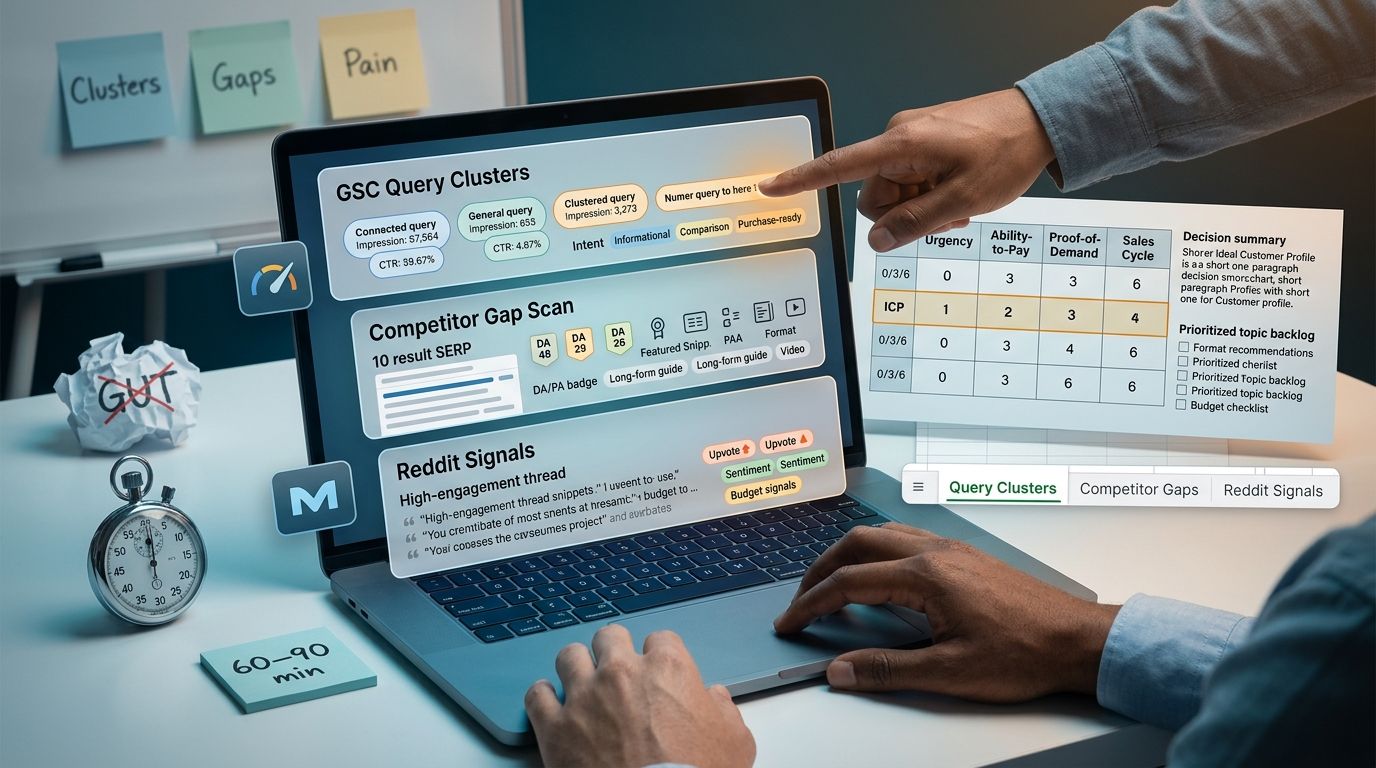
The fix is not more brainstorming. It's an evidence layer built from three signal sources most teams never bother to combine: GSC query clusters (what your market already searches for), competitor gap sampling (where incumbents leave openings), and Reddit pain mining (whether real people hurt enough to spend money).
This guide walks through a single workflow that produces two outputs: a scored ICP decision with a clear stakeholder trail, and a prioritized topic backlog. Total time investment: 60 to 90 minutes.
One data point anchors why this matters. According to the Salesforce State of Sales report, 86% of business buyers say they're more likely to purchase when a vendor understands their objectives. Yet most niche decisions never consult the buyer's own language.
Before you can run this workflow, you need a short list of inputs and about 15 minutes of setup.
What You Need Before You Start: Inputs, Tools, and a 15-Minute Setup
Gather these before you begin so the workflow stays continuous.
Required inputs:
- Google Search Console access with at least 3 months of Performance data. If your property surfaces Insights Query Groups (available only for high query-volume properties), those can accelerate Step 1, but they're not a prerequisite.
- A browser with MozBar installed (free version works). This gives you live Domain Authority and Page Authority overlays directly on search results.
- A blank spreadsheet with three tabs labeled: Query Clusters, Competitor Gaps, Reddit Signals.
Optional tooling (step-specific):
- Moz Keyword Explorer, for Keyword Difficulty estimates if you want precision beyond gut-level reads. (Enhances Step 2, not required.)
- Contentpen or similar competitor gap tools, for automated keyword gap extraction. (Enhances Step 2.)
- Phantombuster or Octoparse, for structured Reddit thread scraping at scale. (Enhances Step 3 if you want 500+ data points instead of 50.)
Time expectation: ~60 to 90 minutes for the full pass, broken into four discrete steps. You can pause between steps if needed, but the workflow compounds best when completed in one sitting.
| Step | Time Estimate | Primary Tool | Output |
|---|---|---|---|
| 1: Cluster GSC queries | 15–25 min | Google Search Console + Spreadsheet | Ranked list of 5–10 intent clusters |
| 2: Sample SERP for gaps | 15–20 min | MozBar + Spreadsheet | Competitive accessibility scores per cluster |
| 3: Mine Reddit threads | 20–30 min | Reddit search + Spreadsheet (or Phantombuster) | Top 10 pain points + language bank |
| 4: Score ICP candidates | 10–15 min | Spreadsheet | Scored ICP decision + topic backlog |
Setup done. Step 1 starts with the data you already own.
Step 1: Export and Cluster Your GSC Queries by Intent
Pull Raw Query Data from the Performance Report
Open the Performance report in Google Search Console. Set the date range to the last 90 days. Export all queries with clicks, impressions, CTR, and average position.
If your property is large enough to surface Insights Query Groups, check those first. They provide an AI-generated starting layer of clustered queries organized by topic. But export the raw query data separately regardless. Google's group definitions are dynamic and can shift over time, so raw data gives you a durable foundation that won't change underneath you.
For properties without Query Groups, the raw export is your only starting point. That's fine. Manual clustering on 90 days of data takes 10 to 15 minutes once you know the method.
Group Queries into Intent Clusters
Open the exported data in your spreadsheet's Query Clusters tab. Sort by impressions descending. Scan the top 50 to 100 queries and group them by shared intent, not just shared words.
Label each cluster with an intent tag:
- Informational: "how to," "what is," "guide to" patterns
- Comparison: "best X for Y," "X vs Y," "[tool] alternatives"
- Solution-aware: "[category] software," "[problem] tool," "platform for [job]"
- Purchase-ready: "[brand] pricing," "[product] demo," "[tool] free trial"
Ambiguous queries will appear. Assign each to the cluster where the majority of its impressions land, then flag it for review later.
Here's a concrete example of how this works. Imagine you see these eight query variants in your export:
- "ops workflow automation"
- "automate operations processes"
- "workflow automation for mid-market"
- "best ops automation tool"
- "operations team workflow software"
- "how to automate ops workflows"
- "workflow automation guide"
- "mid-market ops automation platform"
Queries 1, 2, 3, 6, 7 share informational or solution-aware intent. Queries 4, 5, 8 lean comparison or purchase-ready. But they all orbit one core need: automating operational workflows at the mid-market level. These eight variants collapse into one intent cluster. Google's own documentation uses a similar example (their "guacamole dip" clustering case) to illustrate how diverse query phrasing maps to a single underlying topic.
Flag the High-Signal Clusters
Not all clusters deserve attention. Prioritize the ones where demand exists but your content underserves the opportunity.
The specific signal to hunt: high impressions, low CTR. This means Google is showing your pages for these queries (demand exists), but searchers aren't clicking through (your content or title isn't compelling enough, or a competitor's result is capturing the click).
Also check for cannibalization: if multiple pages from your domain appear for queries within the same cluster, Google is splitting your authority. Note these clusters for consolidation.
Output from Step 1: A ranked list of 5 to 10 intent clusters with aggregate impressions, average CTR, and an intent label. Paste this into your Query Clusters tab.
The clusters tell us what the market already wants. The next question is who else is showing up to answer.
Step 2: Sample the SERP to Map Competitor Gaps and Format Norms
Run a 10-Result Scan for Each Top Cluster
Take the primary query from each of your top 5 clusters. Search it in a logged-out, incognito browser window. For each search, note the top 10 organic results.
With MozBar active, capture the Domain Authority (DA) and Page Authority (PA) displayed inline for each result. Copy these into your Competitor Gaps spreadsheet tab as you go, one row per result.
Also record which SERP features appear: Featured Snippets, People Also Ask boxes, video carousels, knowledge panels. These tell you what format Google is rewarding for this intent and where additional entry points exist beyond the standard blue links.
Identify Dominant Formats and Weak Spots
For each ranking page, log the content format: long-form guide, listicle, tool/landing page, video, community thread (like a Reddit or Quora result), or data-driven comparison piece.
If all 10 results share the same format (say, all are long-form guides), that signals strong intent alignment around that format. Publishing something fundamentally different, like a tool page, when Google wants guides will likely result in poor performance. A mismatch in format means low ranking probability.
Look for weak spots: results with low DA relative to the rest of the page, thin content, outdated publish dates, or generic posts that don't address the specific pain implied by the query.
Per a Contentpen testimonial, one practitioner's single competitor gap scan surfaced 7 keyword gaps that a top competitor owned with zero challenge from anyone else. Seven uncovered entry points from one scan.
Score Each Cluster for Competitive Accessibility
Calculate the average DA of 63 across the top 10 results for each cluster. This gives you a rough difficulty benchmark. As a reference point: an average DA of 63 across the top 10 is fairly difficult for a newer or smaller domain to penetrate. If you can find clusters where 3 or more of the top 10 results sit below DA 50, that's a more realistic entry point.
If you have Moz Keyword Explorer access, pull a Keyword Difficulty score. A KD around 42 signals medium difficulty: viable with strong, well-optimized content. Higher than 60, you'll need serious domain authority or a differentiated format to compete.
Mark each cluster as one of three categories:
- Winnable now: Low average DA, clear format gaps, thin incumbent content
- Winnable with effort: Medium DA, some gaps, requires strong execution
- Defer: High DA, saturated formats, no clear angle
Output from Step 2: An updated Competitor Gaps tab with each cluster, the DA range of the top 10, a KD estimate (if available), the dominant format, and specific gaps you identified.
We now know what the market demands and where competitors leave openings. What we do not yet know is whether the people behind those queries are in enough pain to act.
Step 3: Mine 10–20 High-Engagement Reddit Threads for Pain, Budget, and Jobs-to-Be-Done
Select Subreddits and Define Search Parameters
Identify 5 to 10 subreddits where your candidate ICP segments actually talk. For B2B SaaS targeting operations teams, that might be r/startups, r/SaaS, r/smallbusiness, r/operations, r/projectmanagement, or industry-specific subs.
Use Reddit's native search within those subreddits with high-signal strings designed to surface real frustration:
- "hate when"
- "wish there was"
- "frustrated with"
- "can't believe"
- "waste of money"
Profanity is an intensity marker. Threads where people are swearing about a problem reveal genuine, emotional pain, not just mild inconvenience. Scan for it.
Why Reddit instead of surveys? Typical surveys pull roughly 3% response rates. Reddit threads surface unfiltered pain at scale without the ask. Nobody is performing for a survey form. They're venting, comparing, and recommending because they want to.
Extract Data from 10–20 Threads with 50+ Comments Each
Select threads with at least 50 comments. This threshold filters out low-signal posts and ensures you're sampling topics with genuine community engagement.
For each thread, capture:
- Verbatim quote (copy the exact words, don't paraphrase)
- Date (recency matters)
- Sentiment (positive, negative, or neutral)
- Pain category (assign a label like "integration friction," "pricing frustration," "feature gaps," etc.)
Target a minimum of 50 to 100 data points across your thread set. If you're using Phantombuster or Octoparse for scraping, scale to 500 for a more robust analysis.
Pay special attention to any explicit budget or willingness-to-pay signals. Phrases like "I'd pay $100/month for something that just works" or "we switched from X because it cost $500/month and didn't do half of what we needed" are gold. They tell you not just what hurts, but what people will spend to stop hurting.
Categorize and Rank Pain Points
Group your collected quotes into 5 to 8 pain categories. Typical categories we see: "too complex to set up," "existing tools miss X use case," "budget doesn't match value," "support is unresponsive," "can't integrate with our stack."
Score each category using a simple formula:
Frequency × Intensity × Solvability
- Frequency: How many distinct quotes land in this category?
- Intensity: Are people mildly annoyed or genuinely angry? (Profanity, caps lock, and explicit "I'm switching" language indicate high intensity.)
- Solvability: Can you realistically address this pain with your product or content?
Aim for 15 to 20 direct quotes per major category. These form your language bank, a repository of exact phrases you'll use in headlines, meta descriptions, landing pages, and ad copy. The buyer's own words always outperform marketing-speak.
Output from Step 3: A ranked list of the top 10 pain points in your Reddit Signals tab, a language bank of verbatim phrases organized by category, and any recurring budget or constraint signals.
Map Pains to Search Intent Stages
Connect each pain category back to the intent stages from Step 1:
- Informational: Matches "How to fix [problem]" query patterns
- Comparison: Matches "Best [solution] under $50" patterns (any specific budget constraint mentioned on Reddit is a concrete price signal you can map)
- Purchase-ready: Matches "[Product] vs [competitor]" patterns
This mapping closes the loop. You now know which pain categories align with which GSC clusters, and whether the demand you saw in Step 1 connects to real, emotional human problems you found in Step 3.
Three signal layers are now stacked. The remaining problem is turning overlapping signals into a single, defensible ICP decision.
Step 4: Score Candidate ICPs with a Four-Dimension Rubric
Define the Rubric Dimensions
Each candidate ICP segment gets evaluated across four dimensions, each sourced from specific evidence collected in Steps 1 through 3.
Urgency: Derived from Reddit pain intensity scores. Look at curse-word density, willingness-to-pay language, and the volume of 1-to-3-star competitor reviews referenced in threads. High urgency means people are actively suffering and motivated to change.
Ability-to-Pay: Revenue tier of the segment (e.g., companies doing $1M to $50M in revenue = high fit for a mid-market SaaS product). Budget mentions extracted from Reddit threads. Any firmographic data you can layer in.
Proof-of-Demand: GSC impression volume per cluster. Monthly search volume benchmarks if you pulled them from Moz. Cluster size (number of distinct query variants mapping to the same intent).
Sales Cycle / Accessibility: The inverse of Keyword Difficulty. The competitor DA spread (wider spread = more beatable slots). SERP feature availability (Featured Snippets and PAA boxes = additional entry points). Number of identified content gaps from Step 2.
Build a Scoring Table
Use a 0 / 3 / 6 point scale per dimension. Zero means no evidence or disqualifying weakness. Three means moderate signal. Six means strong evidence.
Structure the table with each candidate ICP segment as a row and the four dimensions as columns. Here is an illustrative example showing how to fill it:
| Candidate ICP | Urgency (0/3/6) | Ability-to-Pay (0/3/6) | Proof-of-Demand (0/3/6) | Accessibility (0/3/6) | Composite Score | Confidence |
|---|---|---|---|---|---|---|
| Mid-market ops managers ($1M–$50M rev) | 6 (high Reddit pain intensity, explicit willingness-to-pay quotes) | 6 (revenue tier fits, multiple budget mentions in $50–$200/mo range) | 6 (high GSC impressions across two clusters, 8+ query variants) | 6 (KD 42, 3 of 10 results below DA 50, format gaps identified) | 1,296 | High |
| Enterprise ops directors | 3 (some pain threads, but lower volume) | 6 (high revenue tier) | 3 (moderate impressions, fewer clusters) | 0 (KD above 60, top 10 locked by DA 80+ domains) | 0 | Low |
| Solo consultants / freelancers | 6 (high frustration, frequent venting) | 0 (no budget signals, repeated "can't justify the cost" language) | 3 (moderate search volume) | 6 (low competition in this tier) | 0 | Medium |
Calculate the composite score using multiplication, not addition:
Demand × Competition Weakness × Pain Intensity × Monetization Fit
This is the most important design decision in the rubric. Multiplicative scoring means a zero in any single dimension kills the candidate entirely. A segment with massive search demand but zero ability-to-pay gets a composite score of zero. That's intentional. It prevents you from chasing a niche that looks attractive on one axis but fails on another.
The "Confidence" column records where your data is thin. If you only found two Reddit threads for a segment, that's low confidence on Urgency. If you have no search volume data, that's low confidence on Proof-of-Demand. Transparency about evidence gaps prevents overcommitting to a weak signal.
Make the Decision and Document the Trail
Select the highest-scoring ICP.
Write a one-paragraph decision summary: who the ICP is, what evidence supports the choice, and what trade-offs exist. This paragraph becomes your stakeholder-facing justification. No slide deck required. The scored table and the paragraph are the deliverable.
Example format: "We are targeting [ICP description] because GSC data shows [X] monthly impressions across [Y] intent clusters with below-average CTR, competitor analysis reveals [Z] beatable positions in the top 10 with average DA of [number], and Reddit threads surface acute pain around [specific problem] with explicit willingness to pay [range]. The primary trade-off is [whatever it is]."
The rubric gives you the decision. The worked example below shows how the entire workflow plays out end to end.
Worked Example: From Raw Data to a Prioritized Topic Backlog in One Pass
The Setup
Imagine a B2B SaaS company that's been live for 6 months, targeting mid-market operations teams. They have a GSC property with enough data to surface meaningful query patterns. Their product helps automate operational workflows and reporting.
Clustering and Gap Scan Results
After exporting 90 days of GSC data, they collapse their top queries into 5 intent clusters:
| Cluster | Intent Label | Relative Impressions | Avg CTR |
|---|---|---|---|
| "Ops workflow automation" | Solution-aware | High (largest cluster by volume) | Low (~2%) |
| "Mid-market ops reporting" | Informational | Medium-high | Low-medium |
| "Operations team software comparison" | Comparison | Medium | Medium (~3–4%) |
| "Automate recurring reports" | Solution-aware | Medium | Very low (~1%) |
| "Ops efficiency metrics" | Informational | Lower | Higher (~4%) |
Two clusters stand out: "Ops workflow automation" and "Automate recurring reports." Both show high impressions relative to the rest of the set, paired with the lowest CTR. Content is underserving both.
The SERP scan for these two clusters reveals an average DA of 63 across the top 10 for the first cluster (difficult but not impossible) and a notably lower average DA for the second. In the recurring reports cluster, 3 of 10 top results sit below DA 50, and several are visibly outdated. Eight query variants in the first cluster collapse into one core intent group, precisely the pattern described in Step 1.
KD for the primary query in the workflow automation cluster comes in around 42 (medium, viable with strong content). The recurring reports cluster is lower still, signaling a strong opportunity.
Reddit Pain Overlay
Mining 15 high-engagement threads across r/startups, r/SaaS, and r/operations (including one thread with 200+ comments that dramatically reshapes the pain picture) surfaces three dominant pain categories:
- Manual reporting kills time: Multiple users describe spending hours each week pulling the same reports. High quote volume, high intensity, frequent profanity.
- Tools don't integrate with existing stack: Users describe trying a tool only to abandon it because it doesn't connect to their ERP or project management system. Medium-high intensity.
- Pricing opacity: Users express frustration at not being able to see a price without scheduling a demo. Multiple explicit budget references in the $50 to $200/month range surface across threads.
The 200+ comment thread, focused on "tools that actually save ops teams time," is the single richest source. It contributes the majority of quotes for pain category #1 and reshapes the prioritization: before reading that thread, "tools don't integrate" appeared to be the dominant pain. The sheer volume and intensity of reporting-related frustration in the mega-thread pushes "manual reporting" to the top.
Pain category #1 maps directly to the "Automate recurring reports" GSC cluster. Pain category #2 maps to "Ops workflow automation." The language in the Reddit threads mirrors the GSC query phrasing almost verbatim: "automate reports," "recurring reports," "pull reports automatically." Signal convergence.
Scoring and ICP Selection
Three candidate ICP segments are scored:
| Candidate ICP | Urgency | Ability-to-Pay | Proof-of-Demand | Accessibility | Composite | Confidence |
|---|---|---|---|---|---|---|
| Mid-market ops managers ($1M–$50M rev) | 6 | 6 | 6 | 6 | 1,296 | High |
| Enterprise ops directors | 3 | 6 | 3 | 0 | 0 | Low |
| SMB founders (below $1M rev) | 6 | 0 | 3 | 6 | 0 | Medium |
The enterprise segment scores zero on Accessibility: the SERP is dominated by high-authority domains, KD is well above 60, and there are no identifiable content gaps. The SMB segment scores zero on Ability-to-Pay: Reddit threads in SMB communities repeatedly reference being unwilling to pay for ops tooling ("we just use spreadsheets, can't justify another subscription").
Mid-market ops managers win. Demand, weak competition, and acute pain all converge.
The decision trail: "We are targeting mid-market operations managers at companies with $1M to $50M in revenue because GSC data shows high combined impressions across two solution-aware intent clusters with CTR below 2%, competitor analysis reveals beatable positions (3 of 10 slots below DA 50 in our primary cluster with an average DA of 63 on the harder cluster), and Reddit surfaces acute pain around manual recurring reports, anchored by a 200+ comment thread, with explicit willingness to pay $50 to $200/month. The primary trade-off is a smaller total addressable market versus enterprise, offset by significantly lower competition and shorter sales cycles."
The Topic Backlog
Five prioritized topics mapped to the chosen ICP:
| Priority | Topic | Cluster | Pain Point | Recommended Format | Rationale |
|---|---|---|---|---|---|
| 1 | How to automate recurring ops reports (without engineering help) | Automate recurring reports | Manual reporting kills time | Long-form guide (matches dominant SERP format) | Highest demand-to-competition ratio |
| 2 | Mid-market ops workflow automation: what to automate first | Ops workflow automation | Tools don't integrate | Long-form guide with checklist | High impressions, maps to integration pain |
| 3 | Best ops automation tools for mid-market teams (2025 comparison) | Operations team software comparison | Pricing opacity + integration | Comparison listicle (matches SERP format) | Comparison intent, captures bottom-funnel |
| 4 | Operations reporting metrics that actually matter | Ops efficiency metrics | Manual reporting kills time | Data-driven post with benchmarks | Supports informational cluster, builds topical authority |
| 5 | Why your ops tools don't talk to each other (and how to fix it) | Ops workflow automation | Tools don't integrate | Problem-solution guide | Directly uses Reddit language bank |
Publish order starts with topic #1: highest demand, lowest competition, direct pain-point match. Each subsequent topic reinforces topical authority within the same ICP while targeting a different intent stage.
The Metric That Tells You Whether Your ICP Choice Is Working
After publishing the first 3 to 5 pieces from the backlog, track one leading indicator: the impressions-to-click ratio for your target cluster inside GSC.
If CTR improves within the cluster within 4 to 6 weeks, the ICP-to-content alignment is holding. Your titles resonate. Your content matches intent. Google is showing you more, and searchers are clicking through.
If impressions grow but CTR stays flat, the traffic signal is positive (Google sees relevance) but the click-through signal is weak. This means your content format or messaging is misaligned with what searchers expect. Revisit the format norms you documented in Step 2. Cross-reference the language bank from Step 3. The fix is almost always in the headline, the meta description, or the content structure, not in the topic selection itself.
Re-run the full four-step workflow quarterly, or whenever a new competitor enters the top 5 for your primary cluster. ICP selection isn't a one-time event. It's a signal you recalibrate as the market moves. If your first pass took 90 minutes, the second pass takes 45, because the spreadsheet structure, subreddit list, and SERP benchmarks already exist. The compounding starts on the second cycle.
Useful materials
- State of Sales - Salesforce (presentation)
- Ranking but No Traffic? Don’t Ignore the Key to Success: Organic Click-Through Rate (CTR)
- How to Do Keyword Research for SEO (Moz)
- How to Use Domain Authority for SEO Competitive Analysis (Ahrefs)
- Key Strategies for Achieving Citations in Generative AI Search (Semai)
- Creating high‑quality content (Google Search Central)
- Google Search Quality Evaluator Guidelines (PDF)
- Survey Response Rate: The Ultimate Guide (Formplus)
- Keyword Golden Ratio: How to Find Low-Competition Keywords (Ahrefs)